I've been swamped at work, dealing with appeals, jury trials, and generally seeking justice in a crazy system. So, while some exciting things have been happening in this wonderful beer town called Ann Arbor, I haven't been writing about it.
But today, I can finally catch a little time to mention a few items of interest. First of all, I'm writing this post right at Arbor Brewing, where Old Tjikko spruce beer is on tap today for Arbor Day. $1 of every pint sold gets donated to the Adopt A Park Natural Area Preservation program here in Ann Arbor, which my wife and I have volunteered for and supported for a number of years. It's yet another example of beer people being good people and Arbor's amazing support for community causes. The Arbor Day Old Tjikko is based on a delicious American Pale Ale, full of grapefruity, juicy hops. I can taste the spruce, but it's not too pronounced, making for a balanced beer that'll appeal to any pale ale fan out there.
On May 2, Arbor will have a Summerfest Release Party, where the 2011 Top of the Park schedule will be revealed and a limited edition seasonal beer will be released: Festival Saison. I do love a good saison in the summertime! The party is 5:00-8:00 p.m. in the Tap Room. Festival Saison is brewed with lemon zest, orange peel, and ginger, and will be available at Arbor through the summer, with a portion of sales proceeds going to support Top of the Park. TOP is a local treasure, but it's been struggling each year to make it financially. With the University Musical Society - of which TOP is a part - vulnerable to cuts in government funding for the arts, it's more important than ever to support TOP if it's something that you value in our city.
Over at Wolverine State Brewing Co., May 8 is mug club appreciation day. It's Wolverine's six-month anniversary. Yes, it's Mother's Day, too, so don't forget your mom! Heck, bring her! She can join the mug club, too! If I'm not mistaken, Wolverine will be extending its hours that day. I recall hearing 12:00-8:00, but you might want to check. Mug club members will get half-off on growler fills, $1.50 beers, and a free pizza buffet. Wolverine also has all of its taps full of tasty brews. Anyone, from hop head to malt maven, can find a beer or three to enjoy. I introduced a friend to Wolverine last night, and he looked around, sat back in his chair, sipped his brew, and said that this was the kind of place where he could hang out a lot. He's right: Wolverine is totally that kind of place.
Last but not least - in fact, probably hugest! - Summer Beer Festival tickets go on sale on May 1st. Oh yes, folks, it's getting to be that time of year again, so gear up for two days of brew madness in Ypsilanti! I hope to see you there!
Friday, April 29, 2011


Saturday, April 9, 2011
Wolverine State Brewing Co. comes fully into its - and our - own
People driving by 2019 West Stadium on Ann Arbor's west side might not suspect that a whole lot of great beer is being brewed in that former warehouse tucked behind Comerica Bank, Great Lakes Cycling and Fitness, Advantage Sports, and Big Georges. Those people might not know that if they just turn into the driveway and pull to the back, they'll be greeted by a large, inviting tap room decked out in love for our state and its craft beer industry, a tap room where delicious beer is being poured by a friendly, knowledgable staff. People might miss out on the glimpse of a gleaming brewhouse in the back, or on the experience of sitting at the long, hand made bar or at one of the many tables decorated with maps of Michigan or in one of the easy chairs or sofas around a low table. They might not get to play some foosball or darts or just hang out, perhaps using the free wi-fi while sampling some beer and snacks or maybe eating more substantial food that they brought or ordered in. In other words, all of those folks driving by on Stadium will miss out on something wonderful.
Wolverine State Brewing Co. specializes in lager brewing, and lagers take time to produce. Unlike relatively warm-fermenting ales that can be ready to drink rather quickly, lagers are fermented with yeast that like colder temperatures and take their sweet time to ferment the beer. They then go into cold storage for a long maturation. That cold storage is called lagering, and the whole long process yields brews that are crisp and clean and have gorgeous clarity, the qualities for which lagers are known and prized.
In contrast to the slow process of lager production, Wolverine has matured as a business at an astonishing rate. Sales have increased 500% since the November, 2010, tap room opening, and the brewery recently added two new ten-barrel fermentation tanks and a conditioning tank. Oh, and how about the new bottling line, which will soon be putting out bottles of Wolverine Premium Lager (starting in June), Wolverine Dark Lager (September), and the seasonal Wolverine Winter Lager (November)? Not only will that mean that more Wolverine beers will be distributed in bottles, but also that bottled Wolverine will no longer be contract-brewed but will be made right here in Ann Arbor, with full production control in the capable hands of brewer Oliver Roberts. The company is a full year ahead of schedule in its business growth, and sales are conservatively projected to be 800 barrels in 2011, up from distribution of 150-200 barrels of the contract brewed Wolverine Premium. If you go out to area restaurants and bars, you may have noticed that Wolverine tap handles are appearing in more and more establishments.
Wolverine has also come into its own as a community gathering place, with the taproom becoming what a great pub should be: a friendly place to be, a place that embraces its community and is embraced in turn, a place of camaraderie and good times, big events and small evenings.
I had the pleasure of attending the tap room's first beer dinner on April 3, and I can sum it up by saying: Let it be the first of many! The "Beer Bellies" dinner featured delicious Southern food thoughtfully paired with Wolverine's terrific brews, and it was emceed by Michigan beer guru Rex Halfpenny - the force behind the Michigan Beer Guide - along with Wolverine owners Matt Roy and E.T. Crowe and brewer Oliver Roberts. Happy patrons sat at long tables, connecting with old friends and meeting new ones, and the family-style service was invitingly casual and comfortable. The event epitomized what I love about the beer community and the idea of the "shared table," which I've written about before.
I've also been at Wolverine on quiet afternoons, drinking some beer and chatting with folks or just working on my computer, and watching as representatives of groups or clubs stopped by to check out the tap room as a possible meeting place. I've seen Oliver talking about the beers - education helps bring people into the craft beer fold - taking the time to explain what they are all about. I've seen Pilar's Tamales set up and trivia night getting under way. I've seen people come in solo and in couples and groups, standing room only crowds and calmer times. I've seen a lot of happy folks drinking beer and hanging out, totally comfortable to just be there. In other words, I've seen Wolverine be a place that has thrown itself open to the community, an example of what the best pubs offer, and the community has adopted the place as its own.
I'm thrilled about Wolverine's business success, and I congratulate the entire Wolverine team for it. Perhaps I'm most thrilled about Wolverine's success because it flows directly from its coming into its own as a community place - our place - and that's priceless.
Wolverine State Brewing Co. specializes in lager brewing, and lagers take time to produce. Unlike relatively warm-fermenting ales that can be ready to drink rather quickly, lagers are fermented with yeast that like colder temperatures and take their sweet time to ferment the beer. They then go into cold storage for a long maturation. That cold storage is called lagering, and the whole long process yields brews that are crisp and clean and have gorgeous clarity, the qualities for which lagers are known and prized.
 |
| One of many gorgeous beers at Wolverine |
 |
| Rex Halfpenny, Matt Roy, and Oliver Roberts address the crowd |
I had the pleasure of attending the tap room's first beer dinner on April 3, and I can sum it up by saying: Let it be the first of many! The "Beer Bellies" dinner featured delicious Southern food thoughtfully paired with Wolverine's terrific brews, and it was emceed by Michigan beer guru Rex Halfpenny - the force behind the Michigan Beer Guide - along with Wolverine owners Matt Roy and E.T. Crowe and brewer Oliver Roberts. Happy patrons sat at long tables, connecting with old friends and meeting new ones, and the family-style service was invitingly casual and comfortable. The event epitomized what I love about the beer community and the idea of the "shared table," which I've written about before.
 |
| Getting ready to fill our "Beer Bellies" |
I'm thrilled about Wolverine's business success, and I congratulate the entire Wolverine team for it. Perhaps I'm most thrilled about Wolverine's success because it flows directly from its coming into its own as a community place - our place - and that's priceless.
Wednesday, March 9, 2011
Arbor Brewing Beer Tasting: Stouts
Ann Arborites, do you need some rich and delicious beer to sustain you in the chilly March weather? At Arbor Brewing Co. on Thursday night (March 10), big, roasty, dark-as-night beers will be on offer at the Stout Beer Tasting. ABC is at 114 E. Washington Street in downtown Ann Arbor, right between Fourth Ave. and Main St.
Beer tastings are at 7:00-9:00 the second Thursday of the month, and they are a heck of a lot of fun. Typically including 25-30 beers, the tastings feature a substantial buffet and a chance to try a nice assortment of beers and hang out with fellow craft beer enthusiasts. Oh, and let's not forget that there are door prizes at the end of the evening, too, such as glassware and brewery t-shirts. Tastings are generally around $25 in advance, $30 on tasting day.
Besides the discount, an additional incentive for picking up your tickets early is that these tastings sometimes sell out. The stout tasting was the first that Arbor Brewing ever put on, way back in 1997, and tends to feature a great combination of Irish stouts, milk stouts, coffee and chocolate stouts, imperial monsters, and other less common types.
If you come by, visit my station: I'll be more than happy to pour you a beer. Cheers!
PS: Next month, IPA's.
Tuesday, March 8, 2011
Thanks, Ray! Or: Dude, you saved my homebrew!
Ray Daniels, wherever you are right now, thank you! I should've read your terrific book, Designing Great Beers, sooner. It's an amazing book, and while other beloved books got me off to a great start with homebrewing, I think Designing Great Beers is the book that can take my homebrewing to the next level. With detailed information on every aspect of brewing, from water treatment to grain bills and hop additions, it's a treasure. What I found the other day is that it can even help with the little things, the things that in hindsight look simple. In brewing, simple things matter.
With my students on winter break, and their winter break not coinciding with my kids' winter break (not sure how that mismatch developed, since my employer is the dominant force in Ann Arbor), I had some time on my hands. The homebrewing bug bit me... hard... again, and I decided to brew two batches. The first was an absolutely huge imperial stout from an extract and specialty grain recipe developed by my dear friend Sean "Beer for the Daddy" Nordquist. After a little time with Beer Alchemy on my computer and going back and forth with Sean, I was good to go with the recipe, and the brew day went beautifully (nice job, Sean!). Dark as night, rich, and roasty with aromas of chocolate and coffee, the stout is now percolating away in the fermenter.
I had also been busily formulating an IPA to brew the very next day. I built the recipe on my way back from Utah and wrote a recent post about that experience, and since it was my first recipe formulated totally from scratch, I was particularly excited about it.
Although the brew day went well in many ways, my efficiency was poor. For whatever reason, my last couple of all-grain batches have suffered from low efficiency, with the grains reluctant to yield their sugars in the mash. Intent on hitting the right original gravity, I focused more on that than on volume. I ended up hitting my target gravity, but I was nearly a gallon short. A gallon less beer is a lot, particularly when you put in a whole day of effort to make the stuff. I was not entirely happy.
The solution, post-mashing, is obvious: either go with what you've got, or add some malt extract to bring the beer up to the right gravity and volume. I wanted to do the latter, but how to do so with reasonable precision? That's where Ray's book came in. I am reading it currently, soaking in gobs of information, and I remembered that he covered how to correct gravity in a really accessible, straightforward way. I grabbed the book, and before long I was sitting with a calculator and a scrap of paper figuring out exactly how much dried malt extract to boil up in a gallon of water so that I could hit the full five gallons without sacrificing the original gravity of the beer. Now, I'm not saying that you can't feel your way through this and just measure as you go, but nothing beats having hard numbers laid out in a readily applied manner. It was quick, it was easy, and it worked. I brought the beer up to volume, still hitting the gravity target, and now the IPA, too, is fermenting away. Ray's advice on this is not complicated; in fact, after reading it, I had a "now why didn't I think of that?" moment. But the point is that I didn't think of it, and he did, and he kindly put it into a very well-written book.

The IPA will be ready to rack to the secondary fermenter in about a week, where I'll dry-hop it and let it sit for awhile. As for the imperial stout, I'll bottle that in a little over a week, maybe two, and put those bottles away for a good long time to mature. It was great to brew up a couple of batches after going a long time without - it's the closest thing I've got to meditation nowadays. But the bug hasn't let go yet. Next up is a repeat of the special bitter I brewed nearly a year ago. That's still the fastest-consumed batch I've ever made, a real favorite around here. Time for more.
With my students on winter break, and their winter break not coinciding with my kids' winter break (not sure how that mismatch developed, since my employer is the dominant force in Ann Arbor), I had some time on my hands. The homebrewing bug bit me... hard... again, and I decided to brew two batches. The first was an absolutely huge imperial stout from an extract and specialty grain recipe developed by my dear friend Sean "Beer for the Daddy" Nordquist. After a little time with Beer Alchemy on my computer and going back and forth with Sean, I was good to go with the recipe, and the brew day went beautifully (nice job, Sean!). Dark as night, rich, and roasty with aromas of chocolate and coffee, the stout is now percolating away in the fermenter.
 |
| Looked and smelled like a chocolate milkshake in the kettle |
I had also been busily formulating an IPA to brew the very next day. I built the recipe on my way back from Utah and wrote a recent post about that experience, and since it was my first recipe formulated totally from scratch, I was particularly excited about it.
Although the brew day went well in many ways, my efficiency was poor. For whatever reason, my last couple of all-grain batches have suffered from low efficiency, with the grains reluctant to yield their sugars in the mash. Intent on hitting the right original gravity, I focused more on that than on volume. I ended up hitting my target gravity, but I was nearly a gallon short. A gallon less beer is a lot, particularly when you put in a whole day of effort to make the stuff. I was not entirely happy.
 |
| They looked so promising! |
The solution, post-mashing, is obvious: either go with what you've got, or add some malt extract to bring the beer up to the right gravity and volume. I wanted to do the latter, but how to do so with reasonable precision? That's where Ray's book came in. I am reading it currently, soaking in gobs of information, and I remembered that he covered how to correct gravity in a really accessible, straightforward way. I grabbed the book, and before long I was sitting with a calculator and a scrap of paper figuring out exactly how much dried malt extract to boil up in a gallon of water so that I could hit the full five gallons without sacrificing the original gravity of the beer. Now, I'm not saying that you can't feel your way through this and just measure as you go, but nothing beats having hard numbers laid out in a readily applied manner. It was quick, it was easy, and it worked. I brought the beer up to volume, still hitting the gravity target, and now the IPA, too, is fermenting away. Ray's advice on this is not complicated; in fact, after reading it, I had a "now why didn't I think of that?" moment. But the point is that I didn't think of it, and he did, and he kindly put it into a very well-written book.

The IPA will be ready to rack to the secondary fermenter in about a week, where I'll dry-hop it and let it sit for awhile. As for the imperial stout, I'll bottle that in a little over a week, maybe two, and put those bottles away for a good long time to mature. It was great to brew up a couple of batches after going a long time without - it's the closest thing I've got to meditation nowadays. But the bug hasn't let go yet. Next up is a repeat of the special bitter I brewed nearly a year ago. That's still the fastest-consumed batch I've ever made, a real favorite around here. Time for more.
Friday, March 4, 2011
Winter Beer Festival 2011
On February 26, Arbor Brewing Co. ran a beer bus to the Winter Beer Festival in Grand Rapids for those of us who wouldn't or couldn't stay overnight and were sane about the prospect of driving, and I had the pleasure of being on it. It was a nice bus, with reclining seats, DVD player, bathroom - number ONE only! said our friendly driver, and a cardinal rule: no pukers, again announced by our friendly driver. That's right, puking, even if contained, would be met with a $250 fine. Fair enough. Frankly, I love the beer bus.
Why do I love the beer bus? Simple. It got me safely - and warmly - to and from the beer fest, and the beer fest was amazing. True, I was only a couple of hours into the fest when I realized that my toes were so numb from the cold that you could probably chop them off without my noticing, but that was a small price to pay to attend this incredibly well-run, fun, friendly event. And I even ended up keeping all of my toes and thawing out in a day or two.
The state of Michigan craft beer is strong. The Michigan Brewers Guild now has over 80 member breweries, and the beer festivals hosted by the Guild are attracting record numbers of people. In addition, Guild Enthusiast memberships - for those of us who love and want to support the Michigan beer industry, and heck yes, I'm one - nearly doubled in 2010, according to the Guild. While the mega-brewers are on the decline, craft brewing is a growth industry around the country. In Michigan, where few growth industries are to be found, craft brewing is a bright spot.
We Michigan beer lovers are devoted to the success and enjoyment of that bright spot, and our beer festivals highlight what is truly a partnership between the brewers and those who love their product. Embracing the winter weather, we all tromped through the snow from station to station, talking with the brewers, sipping their elixirs, visiting the several camp fires or reaching up to the propane heaters to warm our paws a bit, and waiting for the ceremonial kegs to be tapped on the beautiful ice bar. We met new friends, reconnected with old ones, and put faces to names we knew from e-mail and Facebook.
Most of the lines, from the entrance line to the lines at most breweries' tables, were manageable. Every one of the beers I had was poured with a smile, and the brewers were happy to answer questions. The Michigan Hop Alliance - a group that I'm very excited about as they gain a foothold in this agriculturally rich and diverse state - had a nice display and some hops for sale, and I enjoyed a deep sniff of a bag of cascade hops while chatting with the growers.
Of course, I tried a lot of great beers, from barrel-aged monsters to winter warmers and experimental brews. In many cases, the festival would be my only opportunity to have a particular beer, and I didn't want to pass it up. That said, there were so many such opportunities that I had to pass many up, and all I can say is this: I can't wait for more of them this summer in Ypsilanti, when the Michigan Summer Beer Festival comes to town for two great days. In fact, I think I dreamed about it while snoozing on the nice warm beer bus on the ride back to Ann Arbor
While waiting for the summer fest, I'm going to continue to drink local and revel in my luck at living in the Great Beer State... And I think I'll also revel in still having my toes.
Why do I love the beer bus? Simple. It got me safely - and warmly - to and from the beer fest, and the beer fest was amazing. True, I was only a couple of hours into the fest when I realized that my toes were so numb from the cold that you could probably chop them off without my noticing, but that was a small price to pay to attend this incredibly well-run, fun, friendly event. And I even ended up keeping all of my toes and thawing out in a day or two.
 |
| Snow? Who cares? |
The state of Michigan craft beer is strong. The Michigan Brewers Guild now has over 80 member breweries, and the beer festivals hosted by the Guild are attracting record numbers of people. In addition, Guild Enthusiast memberships - for those of us who love and want to support the Michigan beer industry, and heck yes, I'm one - nearly doubled in 2010, according to the Guild. While the mega-brewers are on the decline, craft brewing is a growth industry around the country. In Michigan, where few growth industries are to be found, craft brewing is a bright spot.
 |
| Ceremonial kegs on the ice bar |
We Michigan beer lovers are devoted to the success and enjoyment of that bright spot, and our beer festivals highlight what is truly a partnership between the brewers and those who love their product. Embracing the winter weather, we all tromped through the snow from station to station, talking with the brewers, sipping their elixirs, visiting the several camp fires or reaching up to the propane heaters to warm our paws a bit, and waiting for the ceremonial kegs to be tapped on the beautiful ice bar. We met new friends, reconnected with old ones, and put faces to names we knew from e-mail and Facebook.
 |
| Yes, that's an ice hop cone |
Most of the lines, from the entrance line to the lines at most breweries' tables, were manageable. Every one of the beers I had was poured with a smile, and the brewers were happy to answer questions. The Michigan Hop Alliance - a group that I'm very excited about as they gain a foothold in this agriculturally rich and diverse state - had a nice display and some hops for sale, and I enjoyed a deep sniff of a bag of cascade hops while chatting with the growers.
 |
| The ice bar |
Of course, I tried a lot of great beers, from barrel-aged monsters to winter warmers and experimental brews. In many cases, the festival would be my only opportunity to have a particular beer, and I didn't want to pass it up. That said, there were so many such opportunities that I had to pass many up, and all I can say is this: I can't wait for more of them this summer in Ypsilanti, when the Michigan Summer Beer Festival comes to town for two great days. In fact, I think I dreamed about it while snoozing on the nice warm beer bus on the ride back to Ann Arbor
While waiting for the summer fest, I'm going to continue to drink local and revel in my luck at living in the Great Beer State... And I think I'll also revel in still having my toes.
Sunday, February 27, 2011
Back in the saddle
Oh goodness, has it really been about 3 months since my last post? Those dang timestamps don't lie. Despite the fact that one can't help but feel a certain affection for one's blog, I haven't been keeping up with mine. In an effort to change that, I've decided to stop writing for Examiner.com. There are lots of reasons, but a major one is that I want to write for my blog more often, and Examiner was getting in the way. Even though I didn't post for Examiner all that often, I felt like I should, and thinking about it - feeling guilty about it - took up what little writing space and time I had.
I very recently had the pleasure of formulating my first beer recipe from scratch. Previously, I had made recipes from books or the web, often with some customization, and this was the first time I started with a blank page and built the recipe brick by brick. It's going to be an IPA with New Zealand hops, avoiding the ubiquitous uber-citrus west coast IPA style. Now, don't get me wrong: I love a good uber-citrus west coast IPA. I just don't want to make one this time around. We'll see how the NZ hops go with the malt bill, which will offer up some really rich caramel and biscuit flavors.

I started formulating the recipe on the way back from a quick, exhausting business trip to Utah. It was my second trip out there for work, and I was struck by their small but developing craft beer scene. On the first trip, I enjoyed a terrific IPA and a mighty tasty, rich doppelbock, and on this one I had an American pale ale that went wonderfully with my steak dinner. Utah has really arcane and archaic liquor laws, with a division between regular beers (limited to 4% abv, I believe) and what they refer to as "full strength" beers. You can't buy the latter at many places. In response, the craft beer folks have put out a nice selection of the low-alcohol brews to get into that market while going hog-wild on some huge beers. I am impressed.
So, while I wouldn't have thought Utah would be the place to inspire me to start building a beer recipe from scratch, it was. Flying back to the Great Beer State of Michigan, the plane sleepy and quiet, I stretched out across the row I had to myself, started up Beer Alchemy on my Mac, and was off and running. I followed the initial session with a fair amount of research and lots of tweaking the past few days, and I've now put in the order for the ingredients and look forward to brewing this baby up toward the end of this month.
In the meantime, despite the fact that I may have too much beer in my cellar already - it's gotten to the point where we need to drink it strategically in order to avoid some of it going stale (hey, it's a hard job, but someone's gotta do it) - I keep stumbling across terrific beers and buying them. Again, a nice problem to have. Like the other day, when I went into Arbor Farms for butter and flour... yes, that's right, just butter and flour. And I walked out with five or six single bottles after having a terrific conversation about craft beer with one of their beer buyers, another staffer there who is really into craft beer, and a relative newbie who got a fun education in the process.
Of course, there are also the beer events and regular other visits to Ann Arbor's brewpubs, including pouring for the strong ale tasting at Arbor Brewing the other day. Pouring includes sampling, and the beers were amazing. I might rename this particular tasting the "too much of a good thing" tasting, since with every beer over 7% abv and otherwise huge and rich, I felt like someone had hooked me up to a pump and filled me full of air by the end. I couldn't even finish the "thank you" pint they gave me afterwards.
If you're reading this, thanks for doing so. I hope to be posting more often from. This coming week, I plan to brew a couple of batches - the IPA and an absolutely gargantuan imperial stout - and will post about that. And I'll post about my experience at the Michigan Winter Beer Festival in Grand Rapids. Never has being so cold been so worth it.
Friday, November 12, 2010
Wolverine State Brewing Co. opens in Ann Arbor
 |
| Courtesy of Wolverine State Brewing Co. |
As I wrote in my Examiner.com column, Wolverine State Brewing Co. is now open right on Ann Arbor's west side. Folks, this is a nice walk or a quick bike ride from my house, and I gotta admit, I'm excited.
But I'm not just excited about the proximity of this spacious and inviting taproom and brewery. I'm excited about the people, the community, and the beer. Ann Arbor has serious craft beer riches, but there's room for more, and Wolverine brings a specialty in lager beer, dedication to the community and craft beer scene, adventurousness, and fresh energy and enthusiasm.
 |
| Gulo gulo itself, looking thirsty. Courtesy of WSBCo. |
Brewer Oliver Roberts is embracing his opportunity to stretch out and be creative, whether it's on his fresh, citrusy, piney, floral IPA - one of two ales currently on the tap list - or his toasty Pride of Biscuitville biscuit malt showcase. Want a hoppy lager for a change of pace? The Gulo Gulo Northwest Lager is billed as an IPL and features the clean, crisp qualities of a lager married to a Centennial and Cascade hop extravaganza. It's flat out delicious. The Wench's Westside Wheat, which is the other ale on tap and comes in at 3.8% abv, has a nice wheaty bite and a pleasantly hoppy finish as an American wheat should. With its orange-amber color, it's a sunny pour. Or have an emOATable Lager, a creamy, roasty-toasty dark lager with chocolaty characteristics.
Three of the brews are invitingly sessionable. Also inviting is the fact that there's no per-ounce premium on the price for a small (12 oz) or medium (15 oz), so patrons shouldn't feel pressed to buy larger beers based on the pricing. 22 oz pours are available as well, as are flights of 7 oz pours.
Snacks are available in-house, or feel free to order from local restaurants. Their menus are in binders right in the taproom, and they'll deliver to your table or barstool. Add the in-house wi-fi, and you can hang out for quite some time. Pull up a barstool, grab a chair at one of the several tables, or have seat on a sofa or easy chair. Want to play? Foosball and darts are available as well.
Oliver himself may be staffing the bar, and he's happy to educate you about the beer and help you choose one to fit your palate. Or maybe Ann Arbor's own Beer Wench, brewery co-owner and director of sales and marketing E.T. Crowe, will be in the house. My experience thus far is that staff and patrons alike are enthusiastic and friendly, and it's clear that Wolverine is a truly inviting place.
Wolverine is located at 2019 W. Stadium, behind Great Likes Cycling and Fitness and next to Big George's. Hours are M-Th, 3:00-11:00; F/Sat noon-midnight; and Sun noon-5:00. One exception is tomorrow, Saturday 11/13, when the taproom won't open until 7:00 p.m., which is when the grand opening celebration starts.
Saturday, October 16, 2010
First all-grain batch
 |
| So much potential, just waiting... |
There is also a lot of pleasure. My first all-grain batch was something that I have been contemplating for quite some time; I even wrote a post about picking up the equipment to start all-grain brewing back in May. Real life has its way of running interference, so I only recently got around to brewing up this batch, an English brown ale. Figuring that my first extract batch was also an English brown and that it would be somehow fitting if my first all-grain batch was as well, I pulled a brown ale recipe out of Charlie Papazian's Complete Joy of Homebrewing; after brewing his Palace Special Bitter and loving it, I wanted to try another of his recipes. So, I found his Monkey's Paw Brown Ale recipe, got the ingredients, and now finally had a chance to brew it up.
Ah, but first, some more preparation was in order. I closely read - and re-read - and re-re-read - the incredibly helpful "First All-Grain Batch" chapter in John Palmer's How to Brew. Palmer also has a great chapter on batch sparging, and a recent issue of Zymurgy also had an article on this easy sparging method, so I read those, too. As any reader of this blog knows, every batch I've brewed has yielded not only beer but lessons - some, I can do without at this point. So, applying the brewer's version of the old adage "measure twice, cut once," I focused on preparation. It paid off.
 |
| Brewing on a gorgeous day. |
 |
| Spent grains: they gave all they had. |
I am hooked all over again.
Thursday, July 15, 2010
Things that go pop in the night
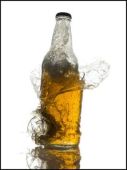
The first bottle exploded in the beer cellar, as I discovered when I went down to grab a beer. My nose told me first. My basement and beer cellar tend to be musty, but I don't usually smell beer down there. This time, I did - good beer, even! Smelling it was like a distant warning signal. Something was amiss, and I initially wasn't sure what it was. It made me take an extra look around, and I saw a splattering of brew on the top of a fermentation bucket. Then I saw speckles of beer in more places, then drips, and then puddles. When I found the offending bottle, I discovered it was a 22-oz. bomber (aptly named) of my homebrewed Belgian-style golden strong ale, and it was on the top shelf of the cellar. It had blown its bottom off - a fact that my children later found quite amusing. The bottom was cracked in half, and both halves were right under the bottle. There was evidence of a bit of beer spray, and a few glass shards, but mostly it appeared that the bottom had blown off and the beer had just gushed out.
About half the bottles on that shelf, and half of the bottles on each of the three shelves below, were sitting in pools of beer. I spent a long, frustrating time pulling all of those out, rinsing them off, and mopping up the mess. I did open a 12-oz. bottle of the same beer, wondering if perhaps it had gotten infected in some way and that the infection had caused the explosion, but the beer was really good. Also really carbonated. Hmmm... Let's see. I had used the right amount of priming sugar, and the final gravity had been on target. So had the original gravity. I wasn't sure what had happened. Finally, I decided that the beer was just a very bubbly brew, and that particular bottle had had a weak spot. After all, it was the only one that had gone.
At least up to that point.
I put out the rinsed bottles to dry overnight on dishtowels in the kitchen, and at 4:18 a.m., I awoke to the sound of another one going. It's hard to wake up at that hour, yanked from a deep sleep, and I wasn't sure what I had heard. But I knew something was wrong, and then it dawned on me that what I had heard sounded like it may well have been...
Yes, a bottle - the same type of 22-oz. bomber, with the same beer in it - had blown up in the kitchen. Again, there were some signs of spray, but mostly evidence of a break and a gush of beer. I cleaned it up again, wondering what might be going on here, and this time I put all bottles of the Belgian-style homebrew in a big plastic bin with a lid. If any blew up, they'd be contained and dangerous only to their fellow beers in the bin.
Interestingly, it's now been a couple of weeks, and no others have exploded. Count me lucky. The beer is very tasty, a richly malty, fruity, somewhat peppery brew with a generous head and long finish. Of course, every bottle I've had has been really carbonated, and I now think I know what must have happened. Although I did check to make sure that the final gravity was within the desired range, I should have checked a few days later to make sure it wasn't fermenting further. I suspect that if I had, I would have seen that the beer had attenuated even more. Instead, I was impatient to bottle the beer, which was a high gravity brew and had been in the fermenter a pretty long time already. In short, I was done with fermentation, but the beer wasn't.
Patience isn't my strong suit, to be sure, but attention to detail generally is. The two traits - impatience and attention to detail - don't really get along. But I can hope that this little brewing lesson sticks: Keep on attending to the details, and be patient enough to allow that attention to be paid throughout the length of the brewing and bottling process. Or be prepared to lose some precious homebrew.
Saturday, June 19, 2010
Craft beer as a family affair
As I've noted several times, my wife is more than supportive of my homebrewing - thank goodness, since it's pretty time-consuming. She's a craft beer lover more generally as well. The other day, when I called as I was leaving work and found that she was home already, she asked what beer I'd like her to grab from the cellar to chill down a bit before I got home. That is love! [As an aside, we enjoyed a couple of bottles of the special bitter I brewed, perfect on a warm, summery evening. Malt-forward with a light bread-crust aroma and flavor, yeast-driven fruitiness, and very crisp hop bitterness, with a soft hop aroma and flavor. Fine carbonation completes the picture. Extremely refreshing; my go-to summertime session beer, as hoped when I brewed it].
So, my wife and I share a passion for great beer. But as Father's Day approaches, I've been thinking: what about our kids? Where do they fit in? No, I'm not talking about kids drinking, as in the Brewed for Tots parody - which I thought was mostly hilarious and just a wee bit scary. But how aware should kids be that their folks are craft beer lovers?
Actually, I think quite aware. This nation sports an uncomfortable combination of a hyper-individualistic, stimulation-seeking, anything goes attitude and pretty significant remnants of puritanism. Together, those clashing values set the stage for some reckless behavior. On top of that, unlike many other countries that have a far lower frequency of alcohol abuse and a lower drinking age, we set our drinking age at 21, marking alcohol as a forbidden fruit and perhaps reducing the opportunities for parents to build alcohol awareness before kids leave home. As we all know, a lot of stupid - and sometimes tragic - behavior ensues. People love to jump into things, and when that involves a hefty dose of rebellion... well, it can all go rather far in a hurry. I wonder if some of that can be avoided - or the risk reduced - by instilling the values of alcohol appreciation and moderation, all the while having fun with cooking and science via homebrewing.
 From the start of my homebrewing adventure several months ago, I involved my kids in the process. My son was part of the crazy emergency trip around town to find a big enough pot to brew my first batch in - after I had started and found that the pot I was using was too small. For his trouble, the first batch was named after him, and since it was an English-style brown ale, he associated it with the knights and castles of medieval England, which he's totally in to. He's also been to the homebrew shop with me, and he was fascinated by all of the equipment and ingredient kits. When we go to a good beer store, he points out Stone beers (gotta love the gargoyles!), Rogue Dead Guy Ale (both of my kids think that the name and the label are just hilarious), and Great Lakes Edmund Fitzgerald Porter (he has learned a lot about the Edmund Fitzgerald disaster and can readily recognize the ship). Together, we're keeping track of the amazing growth and "behavior" of our hop plants, one of which is nearly twice as tall as I am now. He's been amazed at how fast they grow, how they wind themselves around the lines I set up, how they seem to seek out something to climb on, and how their one-way barbs allow them to cling to whatever they can grab. And he knows what hops smell like from homebrewing - "wow, Dad, those smell weird! But kinda good!"
 My daughter, who's a couple of years older than her brother, loves to garden and helped me with stringing lines for the hop plants. She's been fascinated by the idea that we put flowers in beer, and that those flowers help preserve it, and that they have these oils in them that impart flavor and aroma. Since she bakes with my wife, who loves to make sourdough bread and other goodies, she has developed a pretty good understanding of yeast. With a bit of explanation from me, she was able to connect the notions of how yeast makes bread rise and how it ferments beer. She also gets the whole sanitation thing - we don't want other critters in the beer! Like her brother, she's had a batch named for her. At her request, my IPA was even named for her favorite doll, becoming Rosie's Rocket No. 1 IPA. She's tasted malt extract (yum! sweet!) and smelled hops (less keen on them than her brother, at least for now), and like her brother, she asks how the sample is on bottling day and how the beer turned out when I crack that first one open.
Interestingly, my kids have no desire to try beer. They have never asked to try it, and they've specifically and spontaneously stated that it's a grown up drink. They understand more than most kids about how it's made and how much work goes into it, and they know that my wife and I appreciate and enjoy it and that I write about it from time to time. They also know that while we drink it frequently, we drink fairly little in a sitting. In fact, they frequently see us take one 12-oz. beer and split it over dinner, pouring it into two wine glasses. They - especially my daughter - understand that there are sugars trapped in those malted grains, and that malted grains are like any sprouting seed. They understand that when a brewer gets those sugars out, yeast cells just love to eat them up, and those critters make bubbles and alcohol. And they know that we add hops for several reasons during and sometimes after the boil. They've watched me stare at an airlock and sniff at it, and they've asked how things are coming along. I think they respect the process and the result, and I think that the respect they have now could pay huge dividends in the future. As with all things to do with beer - and with lots of other subjects - time will tell.
I wish all of my fellow dads a great Father's Day full of joy and fun. Cheers!

So, my wife and I share a passion for great beer. But as Father's Day approaches, I've been thinking: what about our kids? Where do they fit in? No, I'm not talking about kids drinking, as in the Brewed for Tots parody - which I thought was mostly hilarious and just a wee bit scary. But how aware should kids be that their folks are craft beer lovers?
Actually, I think quite aware. This nation sports an uncomfortable combination of a hyper-individualistic, stimulation-seeking, anything goes attitude and pretty significant remnants of puritanism. Together, those clashing values set the stage for some reckless behavior. On top of that, unlike many other countries that have a far lower frequency of alcohol abuse and a lower drinking age, we set our drinking age at 21, marking alcohol as a forbidden fruit and perhaps reducing the opportunities for parents to build alcohol awareness before kids leave home. As we all know, a lot of stupid - and sometimes tragic - behavior ensues. People love to jump into things, and when that involves a hefty dose of rebellion... well, it can all go rather far in a hurry. I wonder if some of that can be avoided - or the risk reduced - by instilling the values of alcohol appreciation and moderation, all the while having fun with cooking and science via homebrewing.


Interestingly, my kids have no desire to try beer. They have never asked to try it, and they've specifically and spontaneously stated that it's a grown up drink. They understand more than most kids about how it's made and how much work goes into it, and they know that my wife and I appreciate and enjoy it and that I write about it from time to time. They also know that while we drink it frequently, we drink fairly little in a sitting. In fact, they frequently see us take one 12-oz. beer and split it over dinner, pouring it into two wine glasses. They - especially my daughter - understand that there are sugars trapped in those malted grains, and that malted grains are like any sprouting seed. They understand that when a brewer gets those sugars out, yeast cells just love to eat them up, and those critters make bubbles and alcohol. And they know that we add hops for several reasons during and sometimes after the boil. They've watched me stare at an airlock and sniff at it, and they've asked how things are coming along. I think they respect the process and the result, and I think that the respect they have now could pay huge dividends in the future. As with all things to do with beer - and with lots of other subjects - time will tell.
I wish all of my fellow dads a great Father's Day full of joy and fun. Cheers!

Sunday, May 30, 2010
Growth by leaps and bounds
I've got brewing on my mind.
In fact, I find that's the case much of the time. I've caught the bug, bad, and it isn't letting go. I see that as a good thing. After all, the result is delicious homebrew.
Most recently, I brewed two batches about two weeks apart. The first was an organic Belgian-style golden strong ale based on the extract version of the recipe that won the organic brewing competition a year or two ago. After getting it into the fermenter, I had an urge to brew a good session beer for the summer and decided on a bitter, basically following the recipe for Palace Bitter in Charlie Papazian's Complete Joy of Homebrewing.
 The Belgian has been bottled, and it hit the targets for original and final gravity. The sample was very promising, spicy and potent, and I'm eager to see how it matures. The bitter should be ready to bottle by about now. With every batch, I've gotten more and more relaxed about the process. In fact, I find it rather meditative, and I'm able to think more closely about each aspect of brewing. I've gotten into altering recipes to suit my tastes. I've also played around with beginning to create my own recipes. Beer is one of my favorite things; why not make it my favorite ways? I've been encouraged as well by the fact that some of the detail work has become more routine. I'm attentive to it, but I'm not sweating it as much and can really enjoy each aspect of the experience. My wife's been great about it, too. She experiences similar joys in creating fermented foods. Besides, she loves the beer, and that's best of all.
 In addition to brewing more, I've started a hop garden, which now includes a few cascades and a couple of nuggets, courtesy of generous homebrewing friends. It's set against the south wall of the house, and I spent some time today running lines as high as I could get them given my ladder. Now all they've got to do is climb and produce. Thanks to our other cooking pursuits, we have a dehydrator, so any hops I don't use fresh can get dehydrated and stored. In addition to my little hop garden growing, and countless others like it, I'm excited that hop farming is catching on in Michigan! Hops grown right here in the great beer state.
Another kind of growth is on my mind as well. Until now, I've been doing malt extract brews with specialty grains. But homebrewing taps right into my creative side, and I have been dying to do all-grain. I want to experience brewing from the starting line.
After reading a wonderful post by Jon Abernathy on Hop Press about leaping into all-grain - actually, he referred to it as "stumbling," but I still see it as a leap, and a joyous one at that - I just had to do it. I couldn't not do it. So, I picked up some additional equipment from Adventures in Homebrewing over in Taylor. It's a hike from here, but man, those folks are fantastic. Going over there reminds me of going to an old-style, full-serve gas station. You know, the ones that were called "service stations" for a good reason? There was one pretty close to my house in L.A. when I was growing up, and the owner would even stop by our house to check out our car if we were having trouble with it. He and his crew seemed able to fix anything, and the folks at Adventures in Homebrewing are similar. They know homebrewing through and through. Patient and enthusiastic, they'll help with every bit of the shopping and set you up right. Well, now I'm all set up, and I bought the ingredients for a brown ale. My first extract/specialty grain batch was a brown ale, and it feels right that it should be my first all-grain batch as well.
As I've delved deeper into brewing, I've thought increasingly about what goes into the amazing commercial beers I enjoy and the folks that make them. When I'm able to do so time-wise, I'd like to write a series - probably cross-posted on my Examiner.com column - of in-depth features on each of our local breweries. We have some great ones, and I'd like to highlight the folks that make them great and the impact they have on our community.
In fact, I find that's the case much of the time. I've caught the bug, bad, and it isn't letting go. I see that as a good thing. After all, the result is delicious homebrew.
Most recently, I brewed two batches about two weeks apart. The first was an organic Belgian-style golden strong ale based on the extract version of the recipe that won the organic brewing competition a year or two ago. After getting it into the fermenter, I had an urge to brew a good session beer for the summer and decided on a bitter, basically following the recipe for Palace Bitter in Charlie Papazian's Complete Joy of Homebrewing.


Another kind of growth is on my mind as well. Until now, I've been doing malt extract brews with specialty grains. But homebrewing taps right into my creative side, and I have been dying to do all-grain. I want to experience brewing from the starting line.
After reading a wonderful post by Jon Abernathy on Hop Press about leaping into all-grain - actually, he referred to it as "stumbling," but I still see it as a leap, and a joyous one at that - I just had to do it. I couldn't not do it. So, I picked up some additional equipment from Adventures in Homebrewing over in Taylor. It's a hike from here, but man, those folks are fantastic. Going over there reminds me of going to an old-style, full-serve gas station. You know, the ones that were called "service stations" for a good reason? There was one pretty close to my house in L.A. when I was growing up, and the owner would even stop by our house to check out our car if we were having trouble with it. He and his crew seemed able to fix anything, and the folks at Adventures in Homebrewing are similar. They know homebrewing through and through. Patient and enthusiastic, they'll help with every bit of the shopping and set you up right. Well, now I'm all set up, and I bought the ingredients for a brown ale. My first extract/specialty grain batch was a brown ale, and it feels right that it should be my first all-grain batch as well.
As I've delved deeper into brewing, I've thought increasingly about what goes into the amazing commercial beers I enjoy and the folks that make them. When I'm able to do so time-wise, I'd like to write a series - probably cross-posted on my Examiner.com column - of in-depth features on each of our local breweries. We have some great ones, and I'd like to highlight the folks that make them great and the impact they have on our community.
Sunday, May 16, 2010
Trappist and bock tasting at Arbor Brewing Co.
Perhaps you can have too much of a good thing.
 I attended the bock and Belgian Trappist beer tasting at Arbor Brewing this past Thursday. I had a great time, but my goodness, it's tough to sample quite so many huge beers. It wasn't the alcohol. It was the richness! I was walking around feeling stuffed, grossly stuffed, too full to enjoy the nice buffet they always put out at these tastings, which happen on the second Thursday of each month.
I know, I know, poor me.
I am no bock and Trappist expert, though I do remember a lovely evening spent at Great Lakes Brewing Co. in Cleveland when I was 21 or so, enjoying a pitcher of their Rockefeller Bock with friends as I finished up college at Oberlin. That was one of the best beer drinking experiences I have ever had. Since then, I've had bock beers and Trappist ales from time to time, but I wouldn't claim much familiarity. Of course, a tasting is a perfect way to change that.
Trappist Ales
 A mere seven monasteries, six in Belgium and one in the Netherlands, produce Trappist beers. Elegant and complex, many consider these beers to be some of the finest beverages ever made. I was particularly entranced by the tasting table featuring Rochefort 6, 8, and 10. The 6 was a light-bodied brew that featured a roasted nut aroma that carried into the flavor, where it combined with citrus peel. It was dry in the finish, and burnt sugar was prominent there. The 8 was sweeter, fruity, and medium-bodied. It had qualities of brown sugar and toast. The 10 was amazingly complex, managing to have caramel notes, fruitiness, and dryness in the aroma. You might be wondering how it could be dry in the aroma; I wish I could explain better, but that was the impression I had. It was bready, slightly sweet, and fruity on the palate, and coffee and cocoa featured in the finish. I could have lived at the Rochefort table, but that would have meant missing so much goodness elsewhere.
I had a bock beer produced by the Dutch Trappist brewery Koningshoeven. Malty and fruity, I noted a distinct sherry quality as well as chocolate and spice. This beer was rich and smooth, with a velvety, creamy mouthfeel. A real delight.
An example that featured hops more prominently was the Chimay Blue. It had a floral aroma that also had caramel notes, and that caramel quality was prominent in the flavor profile.
Achel Brune was one I had never tried and had heard little about, but I enjoyed it tremendously. There was orange peel and breadiness in the aroma, and a nice combination of spice and orange was present in the taste.
Two examples from Westmalle were available. The dubbel had molasses in the aroma and toast and some roast in the flavors. Then, in the finish, some citrus came through. The tripel was a hazy, golden brew that was earthy and citrusy. It was bready and somewhat tart and fruity in the finish.
Finally, I tried the Orval. It had some funk and citrus in the aroma. This orange-amber brew was dry on the palate, with a bit of spiciness, followed by citrus peel and earthy hops in the finish.
Bock Beers
The tasting featured a very wide variety of bocks, a veritable festival of these strong lagers. I very much enjoyed Arbor Brewing's own Usktratch Mai Bock, which was deliciously toasty-malty and had a balancing bitterness that created a very clean brew.
Anchor Bock was new to me; in fact, I can't recall seeing it in stores here. It was roasty and malty, but then it suddenly changed in character with a really crisp, dry quality. It seemed to start as a heavy beer and then become much lighter at the end.
There was a table with two Aventinus brews. I first tried their Dunkel Weizenbock. I noted some smoke in the aroma, but also a hint of banana. It was an intriguing combination, making me think of well-made fried plantains that get a nice, chewy caramelization. The banana carried through to the flavor, and then this huge, alcoholic warming finish hit. Wow. As if that wasn't enough, I then tried their Weizen Eisbock. This was an astoundingly delicious, smooth beer (at 12% abv, no less). Spice - particularly cinnamon - was notable in the flavor profile. There was a lot more there, but frankly, words don't suffice. Just have some if you get the chance.
I enjoyed two very different Michigan dopplebocks. Bell's Consecrator had a very fruity aroma and prominent caramel flavor. Dark Horse Perkulator was for the coffee lover: this beer was a coffee brew through and through, from aroma to finish, yet it was smooth and tasty. As the pourer said: drink this one only if you like coffee. Luckily, I do.
Spaten Optimator was a full-bodied malt bomb, rich, caramely, bready, but with a mildly bitter finish. It ended up a nicely balanced brew.
Weihenstephan Korbinian featured caramel and toffee in the aroma. Coffee and caramel, a pleasing combination, were present in the flavor. Another brew that had strong toffee notes - as well as roast nut - was Ayinger Celebrator. It finished with a pleasant hop bitterness.
Finally, I'll just mention Ettaler Curator. This was like beer concentrate, syrupy and thick, with chocolate and dark fruit aromas and roast nuts - perhaps chestnut? - and cocoa in the flavor profile.
To shift gears a moment, I just want to mention that I had a very tasty and provocative dopplebock on my recent trip to Utah. Now, as you can imagine, Utah has some interesting alcohol laws, and there's a fair amount of tension about all things related to alcohol. Wasatch Brewing makes a dopplebock called Devastator. The label features the requisite billy goat, but this is one pissed-off goat, rampaging through the streets of Salt Lake City and knocking aside landmarks like the LDS temple and state capitol. I'm sure that's popular amongst some in the state. The write-up on the side of the bottle is worth noting as well. I've include pictures here (with apologies for the quality).


I know, I know, poor me.
I am no bock and Trappist expert, though I do remember a lovely evening spent at Great Lakes Brewing Co. in Cleveland when I was 21 or so, enjoying a pitcher of their Rockefeller Bock with friends as I finished up college at Oberlin. That was one of the best beer drinking experiences I have ever had. Since then, I've had bock beers and Trappist ales from time to time, but I wouldn't claim much familiarity. Of course, a tasting is a perfect way to change that.
Trappist Ales

I had a bock beer produced by the Dutch Trappist brewery Koningshoeven. Malty and fruity, I noted a distinct sherry quality as well as chocolate and spice. This beer was rich and smooth, with a velvety, creamy mouthfeel. A real delight.
An example that featured hops more prominently was the Chimay Blue. It had a floral aroma that also had caramel notes, and that caramel quality was prominent in the flavor profile.
Achel Brune was one I had never tried and had heard little about, but I enjoyed it tremendously. There was orange peel and breadiness in the aroma, and a nice combination of spice and orange was present in the taste.
Two examples from Westmalle were available. The dubbel had molasses in the aroma and toast and some roast in the flavors. Then, in the finish, some citrus came through. The tripel was a hazy, golden brew that was earthy and citrusy. It was bready and somewhat tart and fruity in the finish.
Finally, I tried the Orval. It had some funk and citrus in the aroma. This orange-amber brew was dry on the palate, with a bit of spiciness, followed by citrus peel and earthy hops in the finish.
Bock Beers
The tasting featured a very wide variety of bocks, a veritable festival of these strong lagers. I very much enjoyed Arbor Brewing's own Usktratch Mai Bock, which was deliciously toasty-malty and had a balancing bitterness that created a very clean brew.
Anchor Bock was new to me; in fact, I can't recall seeing it in stores here. It was roasty and malty, but then it suddenly changed in character with a really crisp, dry quality. It seemed to start as a heavy beer and then become much lighter at the end.
There was a table with two Aventinus brews. I first tried their Dunkel Weizenbock. I noted some smoke in the aroma, but also a hint of banana. It was an intriguing combination, making me think of well-made fried plantains that get a nice, chewy caramelization. The banana carried through to the flavor, and then this huge, alcoholic warming finish hit. Wow. As if that wasn't enough, I then tried their Weizen Eisbock. This was an astoundingly delicious, smooth beer (at 12% abv, no less). Spice - particularly cinnamon - was notable in the flavor profile. There was a lot more there, but frankly, words don't suffice. Just have some if you get the chance.
I enjoyed two very different Michigan dopplebocks. Bell's Consecrator had a very fruity aroma and prominent caramel flavor. Dark Horse Perkulator was for the coffee lover: this beer was a coffee brew through and through, from aroma to finish, yet it was smooth and tasty. As the pourer said: drink this one only if you like coffee. Luckily, I do.
Spaten Optimator was a full-bodied malt bomb, rich, caramely, bready, but with a mildly bitter finish. It ended up a nicely balanced brew.
Weihenstephan Korbinian featured caramel and toffee in the aroma. Coffee and caramel, a pleasing combination, were present in the flavor. Another brew that had strong toffee notes - as well as roast nut - was Ayinger Celebrator. It finished with a pleasant hop bitterness.
Finally, I'll just mention Ettaler Curator. This was like beer concentrate, syrupy and thick, with chocolate and dark fruit aromas and roast nuts - perhaps chestnut? - and cocoa in the flavor profile.
To shift gears a moment, I just want to mention that I had a very tasty and provocative dopplebock on my recent trip to Utah. Now, as you can imagine, Utah has some interesting alcohol laws, and there's a fair amount of tension about all things related to alcohol. Wasatch Brewing makes a dopplebock called Devastator. The label features the requisite billy goat, but this is one pissed-off goat, rampaging through the streets of Salt Lake City and knocking aside landmarks like the LDS temple and state capitol. I'm sure that's popular amongst some in the state. The write-up on the side of the bottle is worth noting as well. I've include pictures here (with apologies for the quality).


Quick review: Short's Cup a Joe coffee creme stout
Though there is a tradition of drinking beer at breakfast, I've not been one to indulge. Til today. Out of coffee filters and desperate for a cup of joe, I had a Short's Cup a Joe coffee stout. Brewed with fair trade, organic coffee from Higher Grounds Trading Co., the beer pours an oily, thick, dark brown with a substantial, persistent, tan head that, as you can see in the picture, got away from me on the pour.
 The aroma is dark roasted, coffee, with some berry-like, dark fruit. Mouthfeel is rich and creamy, the influence of milk sugar evident. The flavor screams coffee. Dark, delicious, kick-back-with-the-morning-paper coffee. There's a pleasant, fruity acidity balanced off by sweetness. The finish is long and smooth, cappuccino all the way.

Thursday, May 6, 2010
Suspense. Surprise. Satisfaction.
I love the moment when I get to crack open the first bottle of a new batch of homebrew. From listening for the sharp "hsssst" that indicates good carbonation to seeing the head, color, clarity (or lack thereof), taking in the aroma, and having that first taste, it's a total sensory experience.
It's a moment full of suspense. Sure, I could see how things were going while I boiled the stuff, and I sampled some flat brew during bottling, but the moment of truth is that first bottle. The beer is young at that point and will certainly continue to change, sometimes in surprising or even drastic ways, but I find I get a strong indication of how it'll turn out down the road from that first bottle.
The other day, I got to have this experience again. My IPA had been in the bottle for around nine days, and it was finally time to have one. The hsssst sound wasn't quite as sharp as I had hoped, but there was some there. I felt tense and excited, really eager to see how this thing that I had put a fair amount of work into had turned out.
The brew poured a glorious amber-orange. I could see it wasn't super carbonated, but it did form a nice head. I do hope that it carbonates a bit more to carry the wonderful aroma, which was full of blackberry and floral qualities - with more subtle citrus notes - as I had intended with the particular combination of hops I had used.
I had the first taste and literally let out a whoop of joy. Firm and malty, slightly sweet, medium-full bodied, and with excellent grapefruit, blackberry, and floral flavors and a sharp, clean, but not overwhelming bitterness. It's rich, delicious, and bursting with flavor. I was surprised, then delighted, and a wave of satisfaction washed over me. A minute later my wife came home, and I handed her the glass and just said, "Try this."
Now, I should mention that we've been drinking a lot of IPA's and double IPA's lately. She had no idea this was the first bottle of homebrew. She smelled the beer, nodded approvingly, and then tasted it and said, "Wow! This is great! What beer is this?" When I said it was the new batch of homebrew, she let out her own little whoop and hugged me to celebrate.
Satisfaction indeed.
Thursday, April 22, 2010
Beer, friendship, and the shared table
Beer-related tweets often include #beerpeopleRgoodpeople, a hash-tagged statement of truth. There are a lot of remarkably generous, kind, fun, smart, and creative people in the beer-loving and beer-brewing world. From craft beer devotees to homebrewers and commercial brewers, the beer world attracts terrific folks. And these folks gather in pubs, at tastings, in homebrew clubs, at festivals large and small, and over meals, not to mention over the net on Twitter and Facebook.

Beer serves as a social catalyst, a bridge between people, and it can also be thought of as part of a broader tradition of shared food and drink bringing people together. Even the president had a "beer summit" - though he appeared to need some advice from the craft brew community about what to serve. Ahem.

Beer is part of this human tradition of the shared table, which seems to transcend cultures and therefore be in us. Beer brings us together, eases tensions (in several ways), and is a social spark. Sure, there are other social catalysts that we can gather around, including other alcoholic beverages. For a goodly number of folks, though, beer is the catalyst of choice, and this clearly isn't limited to craft beer.
At the IPA tasting at Arbor Brewing earlier this month, I met folks similarly dedicated to the enjoyment of craft beer and homebrewing. The beer was fantastic, and so were the people. It was a joy to talk with them about what we were sampling and share tales about the triumphs and tribulations - and utterly comical moments - of homebrewing. I ran into the father of one of my daughter's classmates there. Turns out he's a homebrewer, which I hadn't known. We got to talking, and he informed me that he was growing his own hops. After a little more talk, he offered me a couple of rhizomes. Now, less than two weeks later, I have two Cascade rhizomes ready to plant. Beer people are generous, and beer brings people together.
For me, beer has even helped to rekindle a friendship that has been dear to me for over 25 years. Beer writer Sean Nordquist and I became terrific friends at the age of 12. Seventh grade, new school, awkward adolescence: you get the picture and probably lived it, too. When we were teens, Sean had a space in his family's garage that he cleared out and made into a hangout, and we and a couple of other friends would hang there into the wee hours, drinking strong coffee - brewed beverages have apparently always mattered to us - and talking about life, the universe, and everything. Eventually, though, we went to college far apart and ended up in Florida (him) and Michigan (me).
We were in each other’s weddings, and our friendship at its core has never wavered. But we did go through long periods of not picking up the phone or writing. I think that if you had asked either of us about our closest friends, each would name the other right away. I have no doubt that he thought of me often, as I thought of him. With our history, our friendship was enduring, but actual contact had become too rare.

Now, Sean and I talk often about beer, brewing, and beer writing, but we also talk about so much more: our kids and marriages, politics, our jobs (real and dream), mutual friends, old times, current times, and the times we hope lay ahead, adventures we’d like to share and how we might achieve them – and sometimes how we might not be able to. It's all part of life, and it's all fair game.
I have another friend who moved from Michigan to California, and he and I use Skype to have a beer "together" and chat. He's too far away to share the table or hang at the pub together, just like Sean is, but we do try to keep our tradition of grabbing a beer alive with the technology we have at our fingertips. I've also used technology, particularly Twitter, to connect with other craft beer devotees. I'd love to meet them in person someday, but for now we're having a pretty good time connecting over the internet.
It all comes down to human connection, and for me, beer has facilitated that, and the connection is, in turn, more important than the beer. So, on that note, "Hey, wanna grab a beer?"
Friday, April 9, 2010
IPA tasting at Arbor Brewing Co.
Spice, lemon, pine, flowers, grapefruit, caramel, orange, herbs, apricot, hops forward, malty, balanced, bitter, huge, subtle, dry.
Just a few flavors and descriptions for the brews poured at Arbor Brewing Co.'s fabulous, sold-out IPA tasting last night. Call this blog entry a thank you note.
 The folks at ABC know how to put on an event. There were enough tickets to provide for a great crowd, but it wasn't so crowded that we had to wait for a pour or couldn't move around or pause to chat. The beer selection was wonderful, and there was plenty of brew for all. Fortified by a nice buffet, everyone appeared to have a great time. I met fellow homebrewers, chatted with ABC brewing staff, and communed with my hophead brethren.
Some highlights for me included the frighteningly drinkable Bell's Hopslam and Lagunitas Hop Stoopid. The Bell's featured huge grapefruit aroma and flavor softened by apricots and buoyed by a honey-malt sweetness. The Lagunitas also had apricots in the aroma and was somewhat earthier and very well-balanced. Those were two of the high ABV, 100+ IBU giants tucked down in the cellar, where I could also take a gander at a small beer cellar where ABC barrel ages some brews. A couple of barrels were in active use, with tiny airlocks perched incongruously on top. I'd love to try what's inside.

Here are a few more of the brews that I especially enjoyed:


Just a few flavors and descriptions for the brews poured at Arbor Brewing Co.'s fabulous, sold-out IPA tasting last night. Call this blog entry a thank you note.

Some highlights for me included the frighteningly drinkable Bell's Hopslam and Lagunitas Hop Stoopid. The Bell's featured huge grapefruit aroma and flavor softened by apricots and buoyed by a honey-malt sweetness. The Lagunitas also had apricots in the aroma and was somewhat earthier and very well-balanced. Those were two of the high ABV, 100+ IBU giants tucked down in the cellar, where I could also take a gander at a small beer cellar where ABC barrel ages some brews. A couple of barrels were in active use, with tiny airlocks perched incongruously on top. I'd love to try what's inside.

Here are a few more of the brews that I especially enjoyed:
- Michigan Brewing Co. High Seas IPA: Well-balanced, with a mild sweetness, pine, and lemon. A nice dry finish.
- Bill's IPA Lot from ABC: Tiny batch. Quite golden in color, with an amazing hop flavor sequence of grapefruit, then lemon, then pine, then back to grapefruit. Delicious.
- ABC Arborealis: One of my absolute favorites of the night. Beautiful balance, piney with grapefruit and spice as well. Simply a gorgeous beer. Actually went back for a second sample of this lovely elixir. Apparently, this is on tap at ABC's Corner Brewery in Ypsilanti. ABC, please bring it to the mother ship.
- Founders Double Trouble DIPA: Somewhat vinous aroma joined by citrus and apricot. Citrus and apricot feature in the flavor, but also very floral and somewhat piney. Malty as well, yet didn't feel too heavy. Outstanding.
- Dark Horse Double Crooked Tree: Hefty, malty brew, a bit syrupy, orange and earthy flavors, caramel as well. An amazing beer. Can't wait to have more of this one.
- New Holland Mad Hatter Imperial IPA: Huge, hops forward brew, grapefruit aroma, flavors include pronounced orange and pine.
- Great Divide Titan IPA: Floral but also surprisingly biscuity aroma. Balanced, then bitterness predominates in the finish, offset by a touch of remaining sweetness. Lemony and resiny in the finish.
- Lagunitas Maximus IPA: Huge malt profile with some biscuit, all there to support the citrus and floral hop profile.
- Meantime IPA: The only English IPA in the tasting. Very different than any other beer I tried there. Caramel, toffee aroma. A touch fruity, but not citrusy. Sweetish, with a spicy hop profile. Bitter in the finish.

There were a lot of other terrific brews there, many of which I tried, some of which I sadly didn't get to. Only one brew that I sampled missed the boat, in my opinion, and since it may have been that it was just late in the tasting and my palate was probably toast, I won't say more about it now.
I'm a big fan of ABC. The place has supported the Ann Arbor community and been a huge part of the beer scene here for 15 years. They've hosted too many charity events to keep track of, been instrumental in efforts to keep downtown vibrant, and have supported local farms by sourcing more and more of their menu items from them. Oh, and did I mention that they make fantastic beer, too, in a remarkable range of styles?

ABC has a beer tasting on the second Thursday of every month, and I'm looking forward to several more this year, including bock and Trappist beers next month, fest beers in September, Michigan beers in October, and Belgian ales in November. I'm grateful for the opportunity. In the meantime, the IPA tasting has me looking forward with glorious, delicious anticipation to when my homebrewed IPA is ready. That batch is going into the secondary fermenter for some dry-hopping tomorrow.
Wednesday, April 7, 2010
Maybe the third time really is the charm

Two days after brew day, my five year old woke up super early because he had to go to the bathroom, which just happens to be the room with the easiest to control temperature in the house at this time of year. So, it's where the fermenter is perking along almost like a tiny steam engine. It smells like a brewery in there, or maybe like a hop farm, and he remarked in a sleepy voice, "What is that crazy smell?" Of course, he wasn't surprised at all when I told him it was the beer.

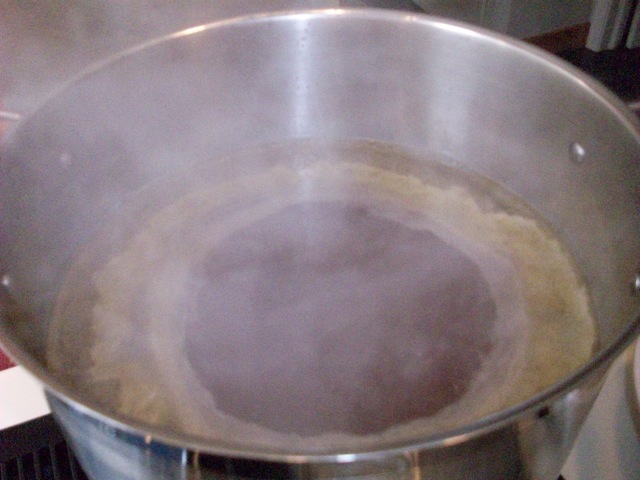

I'm an extract brewer, and a novice at that. As I said, this batch is just my third. The first was a brown ale that went fairly smoothly except for a brief fiasco with a too-small brew kettle, and the second was a steam beer that turned out as a malty amber after I discovered too late that the original gravity was too low when I first brought the wort up to volume; I had to add more malt, and it made it taste like a rich and fruity amber ale. You learn from every batch. Maybe it was that this was my third brew and three's the charm, or maybe it was that the kit was really well put-together, but this batch went great. I was able to totally relax and enjoy as the elixir came together, filling the house with its pungent aroma. The windows were open, music was playing, and making this batch was the meditative experience that I was hoping for. The other two batches were fun to make, but this one was even more than that.
While I've found both of my previous kits (not from Seven Bridges) to be a bit under-malted, this one was perfect. I could have gotten a touch over 5 gallons out of it and still hit the mark on the original gravity, but I wanted the OG a tad high in an attempt to balance the additional hops. The kit was easy to use, and Seven Bridges was straightforward to deal with. The website is pretty well-organized, and my kit arrived promptly and in pristine condition.

Tuesday, March 30, 2010
Why we celebrate Oberon Day
Yesterday was Oberon Day, an official state holiday in Michigan. Lines were out the door at some pubs, and beer stores have artful displays of colorful six-packs with that inviting sun logo. Bell's Brewery has released our beloved spring/summer brew!
 But why do we celebrate the release of Oberon? Is it the gorgeous golden-orange color that virtually luminesces? Is it the rocky pure-white head the color of puffy clouds floating in a blue sky? Is it the spicy-citrus aroma? Is it the dash of orange in the taste, or the touch of clove? Is it the assertive-but-not-too-much carbonation? Is it the finish with the fading citrus gradually replaced with a clean dryness and balancing bitterness?
Well, sure, in part. While some folks pooh-pooh this brew as an "entry" craft beer, I am quite fond of it. It does what it does very well, and much of what it does is refresh. Without meaning to imply in any way that it's simple to make such a beer, I think that Oberon does something that feels simple and straightforward, and it excels at it. Nothing wrong with that.
Even more important, though, is that it heralds the spring and summer, and that means a lot around here. Oberon, in short, is bottled optimism.
Its release signals that people will be getting outside again after a long winter to peer at the sun and feel it warm their bones. It means that the spring thaw is for real, and that the pleasant days will start to outnumber the crappy ones. It means daytime warming and still-crisp nights, and then the heat of the summer will be around the corner. It means flowers and gardens and farmers' markets, outdoor dining, walks and picnics, canoeing and kayaking, and time on the playground with the kids. Here in Ann Arbor, it means that townsfolk and the students lucky enough to stay for the summer will experience the particular joy of summertime in this lovely little city.
For some, it's a reminder of particularly sweet times. My wife and I, after knowing each other for a year in graduate school here, started dating in the warmth of late spring many years ago. She and I had more than a few Oberons together, whether on tap sitting outside at a pub or cracking open bottles in her backyard. Heck, back then, it might still have been called Solsun, but this post isn't meant as a history lesson any more than it's meant to be a beer review. The connections between senses and memory are strong. Really strong. The aroma, taste, feel, and sight of a beer can all be reminders of other times that we've had it, who we were with, what we were doing, or just how we felt.
Perhaps the giddy euphoria on Oberon Day is also about experiencing some optimism in tough times. Our state is wracked by a recession that started way before the nation's did, and it's not likely to recover with the rest of the county. People are out of work or under-employed in droves. There is no clear path forward in Michigan, and our state legislature has been reminding folks lately of clowns running around willy-nilly at a circus: funny, tragic, unpredictable, and somewhat scary in a way that's hard to place exactly. In this environment, the winter can feel particularly cold, dark, and endless.
Yet even here, the craft beer industry is growing. Beer is what many describe as an "affordable luxury," as I discussed a bit in an earlier post. Folks are very loyal to their local breweries and brewpubs, which can become hubs of community activity. Breweries reflect and enhance local flavor in ways literal and metaphorical. They employ local people - not in droves, to be sure, but we shouldn't sneeze at it, either.
We live in a state where the national-scale industries - mainly the car industry and its servant industries - have crumbled and contracted. They remain significant players, but as they've faded, no other industry has stepped in to fill the void. Our governor, echoing the President, points to green energy, and that's a possibility. But we shouldn't ignore the potential of industries that operate on a regional and local level, and brewing fits the bill nicely. Some go national, to be sure, but to me, that mainly means that they need to keep hiring in order to support their expansion, and that's a good thing right about now.
We need Oberon Day. We need that bottle of optimism to unleash our bottled-up optimism, and we should celebrate the release of a major product from one of our greatest breweries. Is this a lot to put on the slender shoulders of a bottle of beer? You bet. But when a beer taps into such a terrific feeling for folks, that's worth some celebration.
Subscribe to:
Posts (Atom)

