Showing posts with label homebrewing. Show all posts

Tuesday, March 8, 2011

Thanks, Ray! Or: Dude, you saved my homebrew!

Ray Daniels, wherever you are right now, thank you! I should've read your terrific book, Designing Great Beers, sooner. It's an amazing book, and while other beloved books got me off to a great start with homebrewing, I think Designing Great Beers is the book that can take my homebrewing to the next level. With detailed information on every aspect of brewing, from water treatment to grain bills and hop additions, it's a treasure. What I found the other day is that it can even help with the little things, the things that in hindsight look simple. In brewing, simple things matter.

With my students on winter break, and their winter break not coinciding with my kids' winter break (not sure how that mismatch developed, since my employer is the dominant force in Ann Arbor), I had some time on my hands. The homebrewing bug bit me... hard... again, and I decided to brew two batches. The first was an absolutely huge imperial stout from an extract and specialty grain recipe developed by my dear friend Sean "Beer for the Daddy" Nordquist. After a little time with Beer Alchemy on my computer and going back and forth with Sean, I was good to go with the recipe, and the brew day went beautifully (nice job, Sean!). Dark as night, rich, and roasty with aromas of chocolate and coffee, the stout is now percolating away in the fermenter.

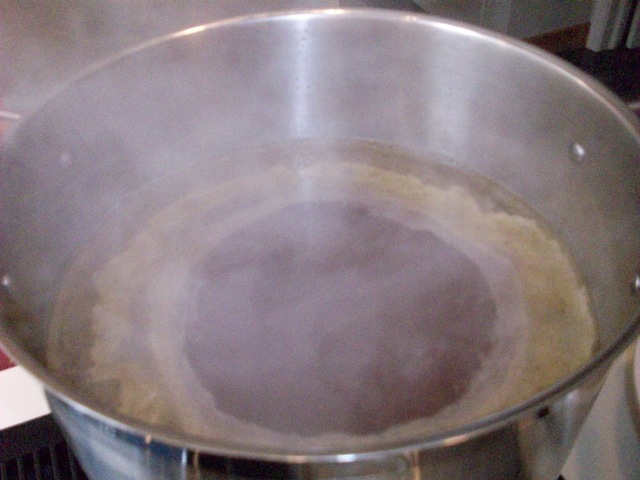
Looked and smelled like a chocolate milkshake in the kettle

I had also been busily formulating an IPA to brew the very next day. I built the recipe on my way back from Utah and wrote a recent post about that experience, and since it was my first recipe formulated totally from scratch, I was particularly excited about it.

Although the brew day went well in many ways, my efficiency was poor. For whatever reason, my last couple of all-grain batches have suffered from low efficiency, with the grains reluctant to yield their sugars in the mash. Intent on hitting the right original gravity, I focused more on that than on volume. I ended up hitting my target gravity, but I was nearly a gallon short. A gallon less beer is a lot, particularly when you put in a whole day of effort to make the stuff. I was not entirely happy.

They looked so promising!

The solution, post-mashing, is obvious: either go with what you've got, or add some malt extract to bring the beer up to the right gravity and volume. I wanted to do the latter, but how to do so with reasonable precision? That's where Ray's book came in. I am reading it currently, soaking in gobs of information, and I remembered that he covered how to correct gravity in a really accessible, straightforward way. I grabbed the book, and before long I was sitting with a calculator and a scrap of paper figuring out exactly how much dried malt extract to boil up in a gallon of water so that I could hit the full five gallons without sacrificing the original gravity of the beer. Now, I'm not saying that you can't feel your way through this and just measure as you go, but nothing beats having hard numbers laid out in a readily applied manner. It was quick, it was easy, and it worked. I brought the beer up to volume, still hitting the gravity target, and now the IPA, too, is fermenting away. Ray's advice on this is not complicated; in fact, after reading it, I had a "now why didn't I think of that?" moment. But the point is that I didn't think of it, and he did, and he kindly put it into a very well-written book.


The IPA will be ready to rack to the secondary fermenter in about a week, where I'll dry-hop it and let it sit for awhile. As for the imperial stout, I'll bottle that in a little over a week, maybe two, and put those bottles away for a good long time to mature. It was great to brew up a couple of batches after going a long time without - it's the closest thing I've got to meditation nowadays. But the bug hasn't let go yet. Next up is a repeat of the special bitter I brewed nearly a year ago. That's still the fastest-consumed batch I've ever made, a real favorite around here. Time for more.

Sunday, February 27, 2011

Back in the saddle

Oh goodness, has it really been about 3 months since my last post? Those dang timestamps don't lie. Despite the fact that one can't help but feel a certain affection for one's blog, I haven't been keeping up with mine. In an effort to change that, I've decided to stop writing for Examiner.com. There are lots of reasons, but a major one is that I want to write for my blog more often, and Examiner was getting in the way. Even though I didn't post for Examiner all that often, I felt like I should, and thinking about it - feeling guilty about it - took up what little writing space and time I had.

I very recently had the pleasure of formulating my first beer recipe from scratch. Previously, I had made recipes from books or the web, often with some customization, and this was the first time I started with a blank page and built the recipe brick by brick. It's going to be an IPA with New Zealand hops, avoiding the ubiquitous uber-citrus west coast IPA style. Now, don't get me wrong: I love a good uber-citrus west coast IPA. I just don't want to make one this time around. We'll see how the NZ hops go with the malt bill, which will offer up some really rich caramel and biscuit flavors.


I started formulating the recipe on the way back from a quick, exhausting business trip to Utah. It was my second trip out there for work, and I was struck by their small but developing craft beer scene. On the first trip, I enjoyed a terrific IPA and a mighty tasty, rich doppelbock, and on this one I had an American pale ale that went wonderfully with my steak dinner. Utah has really arcane and archaic liquor laws, with a division between regular beers (limited to 4% abv, I believe) and what they refer to as "full strength" beers. You can't buy the latter at many places. In response, the craft beer folks have put out a nice selection of the low-alcohol brews to get into that market while going hog-wild on some huge beers. I am impressed.

So, while I wouldn't have thought Utah would be the place to inspire me to start building a beer recipe from scratch, it was. Flying back to the Great Beer State of Michigan, the plane sleepy and quiet, I stretched out across the row I had to myself, started up Beer Alchemy on my Mac, and was off and running. I followed the initial session with a fair amount of research and lots of tweaking the past few days, and I've now put in the order for the ingredients and look forward to brewing this baby up toward the end of this month.

In the meantime, despite the fact that I may have too much beer in my cellar already - it's gotten to the point where we need to drink it strategically in order to avoid some of it going stale (hey, it's a hard job, but someone's gotta do it) - I keep stumbling across terrific beers and buying them. Again, a nice problem to have. Like the other day, when I went into Arbor Farms for butter and flour... yes, that's right, just butter and flour. And I walked out with five or six single bottles after having a terrific conversation about craft beer with one of their beer buyers, another staffer there who is really into craft beer, and a relative newbie who got a fun education in the process.

Of course, there are also the beer events and regular other visits to Ann Arbor's brewpubs, including pouring for the strong ale tasting at Arbor Brewing the other day. Pouring includes sampling, and the beers were amazing. I might rename this particular tasting the "too much of a good thing" tasting, since with every beer over 7% abv and otherwise huge and rich, I felt like someone had hooked me up to a pump and filled me full of air by the end. I couldn't even finish the "thank you" pint they gave me afterwards.

If you're reading this, thanks for doing so. I hope to be posting more often from. This coming week, I plan to brew a couple of batches - the IPA and an absolutely gargantuan imperial stout - and will post about that. And I'll post about my experience at the Michigan Winter Beer Festival in Grand Rapids. Never has being so cold been so worth it.

Saturday, October 16, 2010

First all-grain batch

So much potential, just waiting...
There is a certain magic in starting with a bunch of malted grain and ending up with beer. Magic, and a fair amount of chemistry, attention to detail, and several hours of rather joyful work.

There is also a lot of pleasure. My first all-grain batch was something that I have been contemplating for quite some time; I even wrote a post about picking up the equipment to start all-grain brewing back in May. Real life has its way of running interference, so I only recently got around to brewing up this batch, an English brown ale. Figuring that my first extract batch was also an English brown and that it would be somehow fitting if my first all-grain batch was as well, I pulled a brown ale recipe out of Charlie Papazian's Complete Joy of Homebrewing; after brewing his Palace Special Bitter and loving it, I wanted to try another of his recipes. So, I found his Monkey's Paw Brown Ale recipe, got the ingredients, and now finally had a chance to brew it up.

Ah, but first, some more preparation was in order. I closely read - and re-read - and re-re-read - the incredibly helpful "First All-Grain Batch" chapter in John Palmer's How to Brew. Palmer also has a great chapter on batch sparging, and a recent issue of Zymurgy also had an article on this easy sparging method, so I read those, too. As any reader of this blog knows, every batch I've brewed has yielded not only beer but lessons - some, I can do without at this point. So, applying the brewer's version of the old adage "measure twice, cut once," I focused on preparation. It paid off.

Brewing on a gorgeous day.
On a beautiful day, sunny and clear, not too hot, I set up right in the doorway of my garage. Once the boil began, I'd be back in familiar territory, but first I had to mash the grain. I heated up water to the right temperature so that when it hit the much cooler mass of 10 pounds of grain, the net result would be right on to convert the starches to fermentable sugars. And it worked! It all worked! I'm still shocked and delighted to report that this stuff works! The pre-heated mash tun held the temperature, I stirred when it was time to stir, I measured temperatures, I added some hotter water as needed to maintain the mash at the conversion temp, and sweet heaven, it all worked! What went in as a bunch of grain and water yielded a goodly amount of deep brown, sweet wort, and a quick iodine test indicated that starch conversion was complete. In the meantime, I had heated more water to sparge with, and it all went smoothly. I ended up with about 6.5 gallons of wort ready to boil.

Spent grains: they gave all they had.
About three weeks later, it was time to crack open the first bottle. I always feel a lot of excitement about that moment, and the excitement was even greater because of this batch being a "first." Fresh, grainy, toasty-roasty, malty aroma with a whiff of floral hops. Deep brown color. Nice, creamy head. Malt forward taste mingling with earthy, floral hops. Notes of chocolate and coffee. Medium mouthfeel, which gave the brew a rich, creamy quality but avoided seeming heavy. I was ecstatic. So was the queen.

I am hooked all over again.

Thursday, July 15, 2010

Things that go pop in the night

The sound goes something like this: *pop!*... tinkle ... drip drip drip. It's a bad sound any time. It's worse at 4:18 a.m. I have joined the bottle-bomb club. Beer everywhere. Glass shrapnel. You get the picture, and it wasn't pretty.

The first bottle exploded in the beer cellar, as I discovered when I went down to grab a beer. My nose told me first. My basement and beer cellar tend to be musty, but I don't usually smell beer down there. This time, I did - good beer, even! Smelling it was like a distant warning signal. Something was amiss, and I initially wasn't sure what it was. It made me take an extra look around, and I saw a splattering of brew on the top of a fermentation bucket. Then I saw speckles of beer in more places, then drips, and then puddles. When I found the offending bottle, I discovered it was a 22-oz. bomber (aptly named) of my homebrewed Belgian-style golden strong ale, and it was on the top shelf of the cellar. It had blown its bottom off - a fact that my children later found quite amusing. The bottom was cracked in half, and both halves were right under the bottle. There was evidence of a bit of beer spray, and a few glass shards, but mostly it appeared that the bottom had blown off and the beer had just gushed out.

About half the bottles on that shelf, and half of the bottles on each of the three shelves below, were sitting in pools of beer. I spent a long, frustrating time pulling all of those out, rinsing them off, and mopping up the mess. I did open a 12-oz. bottle of the same beer, wondering if perhaps it had gotten infected in some way and that the infection had caused the explosion, but the beer was really good. Also really carbonated. Hmmm... Let's see. I had used the right amount of priming sugar, and the final gravity had been on target. So had the original gravity. I wasn't sure what had happened. Finally, I decided that the beer was just a very bubbly brew, and that particular bottle had had a weak spot. After all, it was the only one that had gone.

At least up to that point.

I put out the rinsed bottles to dry overnight on dishtowels in the kitchen, and at 4:18 a.m., I awoke to the sound of another one going. It's hard to wake up at that hour, yanked from a deep sleep, and I wasn't sure what I had heard. But I knew something was wrong, and then it dawned on me that what I had heard sounded like it may well have been...

Yes, a bottle - the same type of 22-oz. bomber, with the same beer in it - had blown up in the kitchen. Again, there were some signs of spray, but mostly evidence of a break and a gush of beer. I cleaned it up again, wondering what might be going on here, and this time I put all bottles of the Belgian-style homebrew in a big plastic bin with a lid. If any blew up, they'd be contained and dangerous only to their fellow beers in the bin.

Interestingly, it's now been a couple of weeks, and no others have exploded. Count me lucky. The beer is very tasty, a richly malty, fruity, somewhat peppery brew with a generous head and long finish. Of course, every bottle I've had has been really carbonated, and I now think I know what must have happened. Although I did check to make sure that the final gravity was within the desired range, I should have checked a few days later to make sure it wasn't fermenting further. I suspect that if I had, I would have seen that the beer had attenuated even more. Instead, I was impatient to bottle the beer, which was a high gravity brew and had been in the fermenter a pretty long time already. In short, I was done with fermentation, but the beer wasn't.

Patience isn't my strong suit, to be sure, but attention to detail generally is. The two traits - impatience and attention to detail - don't really get along. But I can hope that this little brewing lesson sticks: Keep on attending to the details, and be patient enough to allow that attention to be paid throughout the length of the brewing and bottling process. Or be prepared to lose some precious homebrew.

Saturday, June 19, 2010

Craft beer as a family affair

As I've noted several times, my wife is more than supportive of my homebrewing - thank goodness, since it's pretty time-consuming. She's a craft beer lover more generally as well. The other day, when I called as I was leaving work and found that she was home already, she asked what beer I'd like her to grab from the cellar to chill down a bit before I got home. That is love! [As an aside, we enjoyed a couple of bottles of the special bitter I brewed, perfect on a warm, summery evening. Malt-forward with a light bread-crust aroma and flavor, yeast-driven fruitiness, and very crisp hop bitterness, with a soft hop aroma and flavor. Fine carbonation completes the picture. Extremely refreshing; my go-to summertime session beer, as hoped when I brewed it].

So, my wife and I share a passion for great beer. But as Father's Day approaches, I've been thinking: what about our kids? Where do they fit in? No, I'm not talking about kids drinking, as in the Brewed for Tots parody - which I thought was mostly hilarious and just a wee bit scary. But how aware should kids be that their folks are craft beer lovers?

Actually, I think quite aware. This nation sports an uncomfortable combination of a hyper-individualistic, stimulation-seeking, anything goes attitude and pretty significant remnants of puritanism. Together, those clashing values set the stage for some reckless behavior. On top of that, unlike many other countries that have a far lower frequency of alcohol abuse and a lower drinking age, we set our drinking age at 21, marking alcohol as a forbidden fruit and perhaps reducing the opportunities for parents to build alcohol awareness before kids leave home. As we all know, a lot of stupid - and sometimes tragic - behavior ensues. People love to jump into things, and when that involves a hefty dose of rebellion... well, it can all go rather far in a hurry. I wonder if some of that can be avoided - or the risk reduced - by instilling the values of alcohol appreciation and moderation, all the while having fun with cooking and science via homebrewing.

From the start of my homebrewing adventure several months ago, I involved my kids in the process. My son was part of the crazy emergency trip around town to find a big enough pot to brew my first batch in - after I had started and found that the pot I was using was too small. For his trouble, the first batch was named after him, and since it was an English-style brown ale, he associated it with the knights and castles of medieval England, which he's totally in to. He's also been to the homebrew shop with me, and he was fascinated by all of the equipment and ingredient kits. When we go to a good beer store, he points out Stone beers (gotta love the gargoyles!), Rogue Dead Guy Ale (both of my kids think that the name and the label are just hilarious), and Great Lakes Edmund Fitzgerald Porter (he has learned a lot about the Edmund Fitzgerald disaster and can readily recognize the ship). Together, we're keeping track of the amazing growth and "behavior" of our hop plants, one of which is nearly twice as tall as I am now. He's been amazed at how fast they grow, how they wind themselves around the lines I set up, how they seem to seek out something to climb on, and how their one-way barbs allow them to cling to whatever they can grab. And he knows what hops smell like from homebrewing - "wow, Dad, those smell weird! But kinda good!"

My daughter, who's a couple of years older than her brother, loves to garden and helped me with stringing lines for the hop plants. She's been fascinated by the idea that we put flowers in beer, and that those flowers help preserve it, and that they have these oils in them that impart flavor and aroma. Since she bakes with my wife, who loves to make sourdough bread and other goodies, she has developed a pretty good understanding of yeast. With a bit of explanation from me, she was able to connect the notions of how yeast makes bread rise and how it ferments beer. She also gets the whole sanitation thing - we don't want other critters in the beer! Like her brother, she's had a batch named for her. At her request, my IPA was even named for her favorite doll, becoming Rosie's Rocket No. 1 IPA. She's tasted malt extract (yum! sweet!) and smelled hops (less keen on them than her brother, at least for now), and like her brother, she asks how the sample is on bottling day and how the beer turned out when I crack that first one open.

Interestingly, my kids have no desire to try beer. They have never asked to try it, and they've specifically and spontaneously stated that it's a grown up drink. They understand more than most kids about how it's made and how much work goes into it, and they know that my wife and I appreciate and enjoy it and that I write about it from time to time. They also know that while we drink it frequently, we drink fairly little in a sitting. In fact, they frequently see us take one 12-oz. beer and split it over dinner, pouring it into two wine glasses. They - especially my daughter - understand that there are sugars trapped in those malted grains, and that malted grains are like any sprouting seed. They understand that when a brewer gets those sugars out, yeast cells just love to eat them up, and those critters make bubbles and alcohol. And they know that we add hops for several reasons during and sometimes after the boil. They've watched me stare at an airlock and sniff at it, and they've asked how things are coming along. I think they respect the process and the result, and I think that the respect they have now could pay huge dividends in the future. As with all things to do with beer - and with lots of other subjects - time will tell.

I wish all of my fellow dads a great Father's Day full of joy and fun. Cheers!

Sunday, May 30, 2010

Growth by leaps and bounds

I've got brewing on my mind.

In fact, I find that's the case much of the time. I've caught the bug, bad, and it isn't letting go. I see that as a good thing. After all, the result is delicious homebrew.

Most recently, I brewed two batches about two weeks apart. The first was an organic Belgian-style golden strong ale based on the extract version of the recipe that won the organic brewing competition a year or two ago. After getting it into the fermenter, I had an urge to brew a good session beer for the summer and decided on a bitter, basically following the recipe for Palace Bitter in Charlie Papazian's Complete Joy of Homebrewing.

The Belgian has been bottled, and it hit the targets for original and final gravity. The sample was very promising, spicy and potent, and I'm eager to see how it matures. The bitter should be ready to bottle by about now. With every batch, I've gotten more and more relaxed about the process. In fact, I find it rather meditative, and I'm able to think more closely about each aspect of brewing. I've gotten into altering recipes to suit my tastes. I've also played around with beginning to create my own recipes. Beer is one of my favorite things; why not make it my favorite ways? I've been encouraged as well by the fact that some of the detail work has become more routine. I'm attentive to it, but I'm not sweating it as much and can really enjoy each aspect of the experience. My wife's been great about it, too. She experiences similar joys in creating fermented foods. Besides, she loves the beer, and that's best of all.

In addition to brewing more, I've started a hop garden, which now includes a few cascades and a couple of nuggets, courtesy of generous homebrewing friends. It's set against the south wall of the house, and I spent some time today running lines as high as I could get them given my ladder. Now all they've got to do is climb and produce. Thanks to our other cooking pursuits, we have a dehydrator, so any hops I don't use fresh can get dehydrated and stored. In addition to my little hop garden growing, and countless others like it, I'm excited that hop farming is catching on in Michigan! Hops grown right here in the great beer state.

Another kind of growth is on my mind as well. Until now, I've been doing malt extract brews with specialty grains. But homebrewing taps right into my creative side, and I have been dying to do all-grain. I want to experience brewing from the starting line.

After reading a wonderful post by Jon Abernathy on Hop Press about leaping into all-grain - actually, he referred to it as "stumbling," but I still see it as a leap, and a joyous one at that - I just had to do it. I couldn't not do it. So, I picked up some additional equipment from Adventures in Homebrewing over in Taylor. It's a hike from here, but man, those folks are fantastic. Going over there reminds me of going to an old-style, full-serve gas station. You know, the ones that were called "service stations" for a good reason? There was one pretty close to my house in L.A. when I was growing up, and the owner would even stop by our house to check out our car if we were having trouble with it. He and his crew seemed able to fix anything, and the folks at Adventures in Homebrewing are similar. They know homebrewing through and through. Patient and enthusiastic, they'll help with every bit of the shopping and set you up right. Well, now I'm all set up, and I bought the ingredients for a brown ale. My first extract/specialty grain batch was a brown ale, and it feels right that it should be my first all-grain batch as well.

As I've delved deeper into brewing, I've thought increasingly about what goes into the amazing commercial beers I enjoy and the folks that make them. When I'm able to do so time-wise, I'd like to write a series - probably cross-posted on my Examiner.com column - of in-depth features on each of our local breweries. We have some great ones, and I'd like to highlight the folks that make them great and the impact they have on our community.

Thursday, May 6, 2010

Suspense. Surprise. Satisfaction.

I love the moment when I get to crack open the first bottle of a new batch of homebrew. From listening for the sharp "hsssst" that indicates good carbonation to seeing the head, color, clarity (or lack thereof), taking in the aroma, and having that first taste, it's a total sensory experience.

It's a moment full of suspense. Sure, I could see how things were going while I boiled the stuff, and I sampled some flat brew during bottling, but the moment of truth is that first bottle. The beer is young at that point and will certainly continue to change, sometimes in surprising or even drastic ways, but I find I get a strong indication of how it'll turn out down the road from that first bottle.

The other day, I got to have this experience again. My IPA had been in the bottle for around nine days, and it was finally time to have one. The hsssst sound wasn't quite as sharp as I had hoped, but there was some there. I felt tense and excited, really eager to see how this thing that I had put a fair amount of work into had turned out.

The brew poured a glorious amber-orange. I could see it wasn't super carbonated, but it did form a nice head. I do hope that it carbonates a bit more to carry the wonderful aroma, which was full of blackberry and floral qualities - with more subtle citrus notes - as I had intended with the particular combination of hops I had used.

I had the first taste and literally let out a whoop of joy. Firm and malty, slightly sweet, medium-full bodied, and with excellent grapefruit, blackberry, and floral flavors and a sharp, clean, but not overwhelming bitterness. It's rich, delicious, and bursting with flavor. I was surprised, then delighted, and a wave of satisfaction washed over me. A minute later my wife came home, and I handed her the glass and just said, "Try this."

Now, I should mention that we've been drinking a lot of IPA's and double IPA's lately. She had no idea this was the first bottle of homebrew. She smelled the beer, nodded approvingly, and then tasted it and said, "Wow! This is great! What beer is this?" When I said it was the new batch of homebrew, she let out her own little whoop and hugged me to celebrate.

Satisfaction indeed.

Wednesday, April 7, 2010

Maybe the third time really is the charm

It was brewing day here in the House of Fermentation this past Saturday. I put together an amply hopped IPA that, I hope, will have just as ample a malt foundation to balance and support the hops. Time will tell, as it always does in brewing.

Two days after brew day, my five year old woke up super early because he had to go to the bathroom, which just happens to be the room with the easiest to control temperature in the house at this time of year.  So, it's where the fermenter is perking along almost like a tiny steam engine. It smells like a brewery in there, or maybe like a hop farm, and he remarked in a sleepy voice, "What is that crazy smell?" Of course, he wasn't surprised at all when I told him it was the beer.

This was my third batch of homebrew, but my first one with organic ingredients, and I want to mention briefly how this came about. I think quite a bit about not just craft beer itself, but the beer business, the place of these breweries in local and regional economies, the environmental impact of brewing and stewardship of the environment by brewers, and community and political involvement by breweries. Along those lines, I recently read Fermenting Revolution: How to Drink Beer and Save the World by Christopher Mark O'Brien. In the course of touching on many aspects of the industry, the environment, and politics, he made a pretty compelling case for brewing with organic ingredients as much as possible.

Brewing with organic ingredients is totally consistent with how we cook at home, and O'Brien discussed his involvement with Seven Bridges, an organic brewing supply coop in Santa Cruz, California. So, I visited their website, and before long, I had ordered up an organic IPA recipe kit. I also ordered some additional hops to spice it up further. Now, I've finally gotten to brew it up.

I'm an extract brewer, and a novice at that. As I said, this batch is just my third. The first was a brown ale that went fairly smoothly except for a brief fiasco with a too-small brew kettle, and the second was a steam beer that turned out as a malty amber after I discovered too late that the original gravity was too low when I first brought the wort up to volume; I had to add more malt, and it made it taste like a rich and fruity amber ale. You learn from every batch. Maybe it was that this was my third brew and three's the charm, or maybe it was that the kit was really well put-together, but this batch went great. I was able to totally relax and enjoy as the elixir came together, filling the house with its pungent aroma. The windows were open, music was playing, and making this batch was the meditative experience that I was hoping for. The other two batches were fun to make, but this one was even more than that.

While I've found both of my previous kits (not from Seven Bridges) to be a bit under-malted, this one was perfect. I could have gotten a touch over 5 gallons out of it and still hit the mark on the original gravity, but I wanted the OG a tad high in an attempt to balance the additional hops. The kit was easy to use, and Seven Bridges was straightforward to deal with. The website is pretty well-organized, and my kit arrived promptly and in pristine condition.

I'm eager to get my next kit from Seven Bridges; I've got my eye on a Belgian-style golden ale, which just sounds awfully good right now. And I have to admit, it feels rather good to brew organic. I'm curious about whether the availability of organic barley and hops will increase and whether we'll be seeing more commercial breweries brew up organic offerings. Just like with every batch, time will tell, though if it's something people want to see, they needn't wait to make their voices heard at their favorite breweries.

Monday, January 25, 2010

Adventures in homebrewing, indeed

My favorite homebrew supply shop is Adventures in Homebrewing in Taylor, just beyond the Detroit airport.  It's not that I can't get supplies in Ann Arbor, but there's no dedicated homebrew shop here, and the selection is limited.  Besides, Adventures is a terrific shop staffed by great people who really know their stuff.

But this isn't about the store.  It's about the fact that it's aptly named.

I wrote in my previous post that the low-down on my second batch of homebrew, my attempt to make a steam style beer, was a whole other story.  This is that story, though at the time I wrote the previous post, I didn't know whether it would end well.  Now I know.

We learn in woodshop class, or from a parent or mentor, or via hard lessons of one sort or another to "measure twice, cut once."  How about measuring at all?  That'd be a good start; after all, sometimes after you measure just once, you still end up cutting just once, and it turns out OK.

I had bought a recipe kit for steam beer in homage to one of my all-time favorites and intro's to craft beer, Anchor Steam.  The long and the short of it was that it was under-malted.  There wasn't enough malt extract in the kit to make the promised five gallon batch and have the original gravity fall within the desired range.  That's a bummer, but it's no big deal, because any beer-loving, would-be-homebrewer doofus with a batch under his or her expanding belt-line probably ought to know to take gravity readings while adding water to bring the wort up to volume.  This particular doofus did so while making the tasty brown ale - still so enjoyable as I get down to the last bottles - and just made about 4.5 gallons instead of 5, because that's when I hit the right gravity range.  Yet for whatever reason, or no reason, I just didn't do it this time until I had brought the volume up to 4.5 gallons.  Then, some little synapse went "bing," and I thought to measure the gravity.  Way low.  Already.  At 4.5 gallons.  I cursed a bit, staved off panic, and turned to The Complete Joy of Homebrewing by demigod Charlie Papazian, the man who wrote about how to brew beer at home long before it was re-legalized.  Sure enough, in the "troubleshooting" section, there was some advice about this very situation.  He suggested that one could just ferment what one's got and chalk it up to experience - the option he preferred - or one could add some malt extract.  Of course, he indicated how much malt extract - based on liquid malt extract.  And oh yeah, he also advised as always that I relax, not worry, and have a homebrew.  Generally, that's terrific advice, but I needed to grab some more malt extract first.

So, on an icy night, off I went to the local homebrew shop, and I bought some malt extract.  Dried malt extract.  See, they were out of the right liquid extract, and I hadn't quite gotten to the part in the book where Charlie indicates that there's a difference as far as what it'll do to your gravity.  Or I hadn't noticed.    Either way, I went home and poured in the extract.  In fact, rather a lot.  And again, I didn't measure as I went.

My gravity was sky-high.  Have I already mentioned that I am a doofus?

Now friends, there are worse things than having a high-gravity beer.  In fact, I drink a lot of those - though not a lot at once - and love them.  Besides, I still had some room to bring the beer up to volume, so I brought it up to the full 5 gallons, and the gravity was still high, but no longer ridiculous.  I capped the fermenter and, like Charlie suggests, relaxed, tried not to worry, and had a homebrew.  Of course, now I was worried not only about the gravity but about the possibility that I introduced an infection into the cooled wort when I added the malt.  But the tasty homebrew helped, just like Charlie says.

In case you haven't noticed from these posts, there's a seat-of-the-pants, experimental quality to homebrewing, even when using a well-regarded recipe kit.  It's not a hard thing to do, let me tell you.  It ain't rocket science.  But there are several variables, and attention to detail is very helpful.  Measure twice, cut once.

The beer was three weeks in the fermenter.  Even so, the final gravity was higher than the desired range, meaning that there were sugars in there that the yeast hadn't metabolized.  I had already stirred it up gingerly and reluctantly after the two week mark in an effort to restart fermentation, risking oxidation, but the yeast wasn't having any of it.  It was time to bottle it and move on.  When I sampled a touch of the flat beer during bottling, at first I thought that it was an overly malty, unbalanced mess.  But on my second sip, there was some nice bitterness and hop aroma there.  That's how hope smells and tastes, in this case.

Two weeks in the bottle, and the Queen and I cracked one open, and I feel very fortunate as I write that it was very good.  Amber with bright ruby highlights, a thick, creamy, off-white head that dissipated pretty slowly.  The carbonation wasn't too intense, but just right to carry some fresh, spicy, floral aroma.  It had a rich mouthfeel but avoided being too heavy, and while somewhat sweet, it was balanced by a pretty assertive (but not overwhelming) bitterness and notes of spice, pine, and flowers.  It's like a steam-amber ale hybrid, and it's pretty darn delicious and a definite session beer.  I look forward to more as it matures further in the bottle.  The Queen even opened a second bottle on its inaugural night, and if that isn't a favorable review, I don't know what is.

My buddy Sean had mentioned before and after my bottling-day sampling that I shouldn't be concerned yet, since the beer could still end up being terrific.  Another lesson learned.

Homebrewing yields lessons in every batch.  I can't wait to start the next one, and at this point, I know enough to avoid some mistakes, and also to expect to learn some more lessons.

Saturday, December 19, 2009

Brewing day!

It's brewing day in the House of Fermentation.  I've been dying to brew up my second batch o' homebrew, this time a steam style (aka California common) beer as a nod to one of my first true beer loves, Anchor Steam.  And, since the style involves using lager yeast fermented at ale temps, it should work well in our house, which we keep cool in the winter.

I've had a lot of time off lately, using up leave from what will shortly be my old job and getting ready for a new gig, but I've managed to be really busy anyway.  Just when I was starting to wonder when I'd get some time off during my time off, I got today.  The Queen of Fermentation planned a bunch of activities for her and the kids, and I woke up knowing that TODAY WAS THE DAY!  Brewing day!

So, I am writing this quick post surrounded by hop-scented steam swirling around the kitchen, the sound of boiling wort emanating from the brew kettle.  I love this.  I love the aroma and the sound, the attention to detail and the anticipation.  The fermentation bucket is sanitized, I'm almost ready to add the finishing hops, and then it'll be on to cooling the wort, transferring it to the bucket, and pitching the yeast.

The brown ale I brewed up has been really well-received by various friends, which of course just encourages me to brew more.  I'm thinking about getting a carboy for secondary fermentation - hey, if you have thoughts on this, add them to comments - and I might even get another fermentation bucket so that I can do more than one batch.  Beer is intoxicating.  Brewing might even be more so.  There's the timer... time to add the finishing hops.

Friday, December 4, 2009

Homebrewed English Brown Ale: a postscript

A few extra days of cellaring and conditioning has really rounded out the homebrew's flavor profile.  Served in a red wine glass at cellar temperature, it has a malty aroma: a bit of bread, lots of brown sugar, some chocolate.  Hops are present too, just a bit of flowers coming through.  The taste is a touch sweet, the brown sugar is there, as is the chocolate.  It has a nice, medium mouthfeel, and the carbonation is feeling just right.  The hops provide that key bit of balance, with the floral notes and bitterness coming through softly.  The finish is rather long, with that brown sugar and chocolate combo remaining balanced off by the hops.

Now, it's not like I made this recipe up.  Far from it!  My hat's off to Brewer's Best for putting the kit together.  So, don't take this post as me saying that I've come up with something great.  Rather, I'm quite impressed with the kit, and this beer has turned out very nicely, particularly for a first batch of homebrew.  If you're reading this and thinking about homebrewing, go for it!  You can make some good beer right from a kit and learn a ton in the process.

My boy, Sir E, is proud of his English Brown Ale.

Thursday, December 3, 2009

Homebrewing: Batch brewed, lessons learned, part two

Welcome back to the House of Fermentation!  When we left off, I had managed to spill some water into the wort from the unsanitized airlock.  Not the most auspicious moment, but everything is a lesson.  The question was whether this lesson would be a harsh one.

I put the fermenter in the laundry room and set our space heater, which has a thermostat, to what had been described by the Adventures in Homebrewing folks as an ideal temperature for the particular strain of yeast I was using.  I wanted those sweet babies to be comfortable.

The next morning, I went in there first thing, hoping for bubbles in the [potentially germ-ridden and thus catastrophic to my brew because of my idiotic spill] airlock water.  And there were!  Signs of life!  The right kind of life!  At least so far!  Fermentation confirmed!

In the meantime, in the spirit of sibling harmony, I had already promised my 7-year-old that the next batch would be named after her.  In fact, I already know the style: steam beer, aka California common.  The reasons were straightforward enough.  As a reader of this blog, you may recall from an older post that I have a particular love of Anchor Brewing, including its flagship Anchor Steam Beer.  I want to brew something like that.  Obviously, on just my second batch, and using extracts instead of having the control of all-grain (where you mash the malt yourself), it might not match up, but I want to try.  But it's not just about love and reverence.  There's also a practical reason: steam beer is made with lager yeast but fermented at closer to an ale temperature.  Lager yeasts ferment at much lower temperatures than most ale yeasts, and I don't want to be using that space heater quite so much next time around.  So, by using a lager yeast at the temperature at which the House of Fermentation hovers in the winter, I can brew up a batch of steam beer without resorting to the heater.

Down in the basement, the yeasts continued to work their magic.  Day after day I went down, and day after day I saw triumphant, burbling bubbles rising to the surface of the airlock at regular intervals.  If I sniffed at the right time, I could catch a whiff of the developing beer.  The aroma was still on target.  Hope was building.

Instead of the 4-6 days that had been described, I had active bubbles for 7-8 days, and then let it rest as instructed for 2 more days.  There are stories out there of exploding bottles caused by bottling beer that is still fermenting too actively.  Glass shrapnel, huge mess... hmm, best avoided, no?

Waiting to bottle the beer, I finally did something that I'd suggest a novice homebrewer do much sooner. I watched the incredibly helpful, straightforward videos at homebrewingvideo.com.  I started off watching the ones about the bottling process and ended up watching them all.  Lots of useful tips in there!  In fact, Video-man mentioned the importance of sanitizing the airlock.  Ouch!  Anyway, I was ready to bottle my elixir.

I sanitized my clean bottles, bottling bucket, and all other equipment.  Then I opened the fermenter, and the aroma of freshly brewed beer filled the kitchen!  Malty, a bit bready, some lovely floral overlay of hops... I had made beer!  Flat beer.  Now it needed to condition in the bottles.  I boiled up a solution of priming sugar as instructed and put it in the bottling bucket.  My dear yeast would be well-fed one last time and carbonate my beer in the bottles.  Perhaps I should mention here that by now, I had fallen in love with the yeast.  It feels a bit odd to fall in love with a microbe.  Sure, I have always had a healthy respect for yeast, given my admiration of beer and bread, not to mention hard cider and wine, but working with them on this first batch, I think I fell in love.  I'm not proud to admit it.  In fact, I should probably get some help for this, but I want to be honest here.

Now, on to the transfer from fermenter to bottling bucket.  Siphoning looked very easy on the video. Obviously, since I went through all the trouble of sanitizing everything, sucking the tube to get it started wasn't an option.  I primed the racking (siphon) tube using sanitizing solution, as instructed, and got it started by running some water "backward" into the tube and then lowering and opening the tube to start the flow, as instructed.  It took me three tries to get the flow.  Video-man did it in one.  Video-man was an expert, but really, we're just talking about siphoning.  I have no excuse.

I got it flowing just in time to stave off panicky thoughts of failure, stopped the flow, transferred the racking cane and tube to the fermenter, and let the flow start again, first into a cup to let the sanitizer out.  Once beer was flowing, I lowered the tube into the bottling bucket, and within minutes I had a lovely bucket of beer there, ready to bottle.


Bottling was straightforward enough.  There's a handy (when it works) valve on the end of the bottling tube that only allows beer to flow (when it works) when it touches the bottom of a bottle.  Did I mention that it didn't work all that reliably?  I mean, it definitely allowed beer to flow, but let's just say it didn't always stop on cue.  Video-man had said to put towels under the bottling area, and never, never, never bottle over carpet.  I listened to Video-man.  Whew.  I quickly learned to re-tap the valve against the bottom of the bottle every now and then to keep it from sticking.

By the way, it is a painful thing to spill beer that you went through the trouble of making.  When that valve stuck and beer overflowed the bottle and soaked the towels, I wondered if it would be undignified to suck on the towels later.

Capping (remember, sanitize those caps!) was a breeze. I put the bottles back in their warm, cozy, pro-fermentation environment and prepared to wait two weeks.  After bottling, there was a tiny bit of beer -- and a lot of sediment -- left in the bucket, and my wife and I isolated a bit of the liquid and tried it.  Sure it was flat and needed to mature, but it actually tasted pretty darn good!  It was definitely beer.  I appeared to be on the right track.


I looked ahead to the two week wait, and it sounded painfully long.  Lucky for me, my friend Sean -- an experienced homebrewer -- said on the 8th day to go ahead and try it!  It's probably ready!  My wife and I put two in the fridge, and close to dinner time we took them out and let them come up to cellar-ish temperature.  I held my breath opening the first one.  Remember that unsanitized airlock spill-over?  Well, I was sure thinking about it, but the bottle opened with a healthy, sharp hiss and didn't crazily froth over -- which can be a sign of infection -- and it poured beautifully.  Nut-brown color, a nice head, aroma of malty sweetness with just a bit of background hops.  And it tasted... GOOD!  Not fantastic.  But good!  A touch sweet, a bit roasted, a hint of chocolate, nice bittering from the hops along with just a breath of floral quality.  It was an English brown ale, as planned.  My wife and I both enjoyed it.  Sean had said to shoot for drinkability with the first batch.  This one exceeded that expectation.  This homebrewing thing is a whole lot of fun.  Sure, there were anxious moments.  There were even moments of utter folly.  But I'm hooked.

Before the first taste, my 5-year-old was watching intently, and as I sipped it, he asked eagerly, "Is it good?  Is it good?"  And when I told him it was, he crowed gleefully.

After all, it's his namesake beer.

Tuesday, December 1, 2009

Homebrewing: Batch brewed, lessons learned, part one

Friends, since my last post, I have embarked on the homebrewing journey.  For better or worse, I have joined my wonderful wife in playing with microbes here in the "House of Fermentation."  She makes sourdough, yogurt, kefir, and kombucha.  She also soaks grains before cooking with them, just to get a touch of fermentation going and increase digestibility.  Perhaps more to the point, she looks like she's having a hell of a lot of fun, and I gotta say, the results are darn tasty.

I had thought for months about joining the microbial circus by homebrewing, but I would stop myself by thinking about the simple fact that there are a lot of wonderful beers out there.  Did I really need to make beer when there are so many lovely ones to drink?  Eventually, I answered "yes!"  I just couldn't shake the idea!  So, I went to Adventures in Homebrewing in Taylor, MI, where the helpful folks set me up with an equipment kit and ingredients to make English brown ale -- it's a style that I know and like, and the recipe kit was labeled "easy."  I also attended their Teach a Friend to Homebrew Event, where I mingled with novice and expert homebrewers alike and got a lot of good tips.  I was ready.  I was inspired.  I was thirsty.

The next day, I commenced my journey.  I read the instructions and laid out the ingredients in their handy little packets.  As the clerk at Adventures in Homebrewing told me, making beer is not rocket science.  Perhaps not, but by the end, I knew that it might take a minute to learn to brew a beer, but it takes a lifetime to master.  Othello, anyone?

At the homebrewing shop, I had contemplated buying a 5-gallon stock pot, but I was told by one helpful homebrewer that for the boil -- the only step where the pot is needed -- I could get away with a 3-gallon pot.  Hey, we had one of those!  Yes!  Money saved!  Alas, another homebrewer -- one of the super-experts -- had talked about rinsing steeped grains in warm water, which would add to the volume.  And yet another had mentioned that getting into homebrewing to save money on beer is like buying a fishing boat to save money on fish.  It just doesn't work that way.  So, in hindsight, it was misguided to try to go with the 3-gallon stock pot, but try I did.

I put 2.5 gallons of Ann Arbor's finest water into my 3 gallon pot, brought it up to the designated temp, and put the muslin bag of malted grains in.  Glorious!  It steeped to make an aromatic barley "tea," and that was my first hint of what it would become.  Homebrewing is a process of constructing a beer while deconstructing your idea of beer.  Just when you think you know about beer, homebrewing breaks it down to its components, and for me, smelling that steeped barley was a signal moment.  There would be other such moments, like when I broke open the bags of hops, but the first was powerful.

After steeping, I ran warm water through the bag of grain just like one of the homebrewing experts told me, nice and slow, rinsing those additional sugars into my developing wort.  No, I wasn't getting a lesion on my hand or foot.  I mean wort, pronounced wert, which is basically beer pre-fermentation.  It was time to add the malt extracts.  In this recipe, there were liquid and powered malt extracts.  Before pouring in the malt extracts, it occurred to me that the pot was looking awfully full.   But what the hell, I thought, and poured anyway.  All I can say in my defense is that it didn't overflow.

OK, now I had a really full pot of hot, sweet, barley-sugar water.  As in, up-to-the-brim full.  Crap!  I needed a 5-gallon pot right then.  Turns out that these are somewhat harder to find than they should be.  Or than they used to be.  My 5-year-old was standing there, and I asked him if he was up for a little adventure.  As usual, he was, and off we went.  I'll spare you the details, but let's just say he was a total trouper, and after running all over town, we found what we needed.  As an aside, I'll mention that I'm convinced that the relative unavailability of 5-galllong stock-pots is due to the decline in American home cooking.  Several merchants mentioned unhelpfully (but with very helpful looks on their apologetically-smiling faces) that they used to carry them.

Anyway, we finally got a pot and ran home again.  For his troubles and help, I promised my 5-year-old that I would name this beer after him if it turned out.  He appeared pleased at this and then went off to do something more interesting, like play knights or police or something.  There was a ginger transfer of the hot liquid to the new pot, and I was off and running again.  A bit humbled.  Perhaps even ashamed.  But still in business and full of hope.

The rest of the boil went well.  I kept time precisely and added bittering, aromatic, and flavoring hops on schedule.  The aroma was amazing and seemed right.  Simply right.  Fabulous!  After the boil, I cooled the whole shebang in a sink full of cold water, draining and refilling that several times until the wort was at the right temperature.  Then I transferred it without incident to the sanitized fermentation pail and pitched the yeast and aerated it.  I breathed a sigh of relief, but one remaining moment of total shock came next.  I was pressing the airlock into the lid of the pail when some of the water in the airlock went over the edge and into the beer -- totally predictable, given the fact that I was pressing that sucker into a small hole in an otherwise air-tight bucket.  Well, dear reader, I hadn't sanitized the airlock.  I had sanitized everything -- EVERYTHING -- else.  But not the airlock.  It wasn't a lot of water, but let's just say that the same medium that yeast love so much is a wonderful place to grow bacteria.  After some choice words under my breath and some basic relaxation exercises, I shrugged (que sera, sera) and put the pail in the laundry room with a space heater to keep it at fermentation temperature.

Time would tell.

Time did tell.